Skip to content

Emergency plumbing · Phoenix & the Valley

Water Heater Repair Phoenix

A tank emptying onto the garage floor is an emergency; a cold shower with nothing leaking usually is not. Licensed Arizona plumbers repair and replace water heaters across Phoenix, tell you on the phone which one you have, and price the work in writing before it starts.

  • 24/7 Dispatch
  • Licensed plumbers
  • Written Quote
  • Honest ETAs
  • Homes & Business

Schedule Water Heater Repair

24/7 dispatch
US format - we will call or text you back right away.
Add a short message (optional)
How urgent?

Written quote before any work starts. No obligation. Privacy.

Emergency or scheduled?

We tell you on the phone whether this needs a plumber tonight or can wait for the daytime rate.

Written quote first

The price goes on paper before any work starts. If walls have to open, we stop and re-quote.

What's included

Everything the job needs,scoped before we start.

Every water heater repair job in Phoenix includes the work below as standard. It is written into the quote before we start, so there are no surprise extras on the invoice.

  • Phone guidance to close the cold inlet and shut off gas or power before the plumber arrives
  • Diagnosis of gas and electric tank units: thermocouples, igniters, gas valves, elements, thermostats, relief valves
  • House pressure and expansion tank check, since a failed PRV kills heaters
  • Same-visit repairs from truck stock where the tank is sound
  • Permitted replacement of 40 to 50 gallon tanks with expansion tank and code upgrades
  • Tankless conversion with gas line and venting sized correctly
  • Photos and a written report for an insurance claim on a ruptured tank
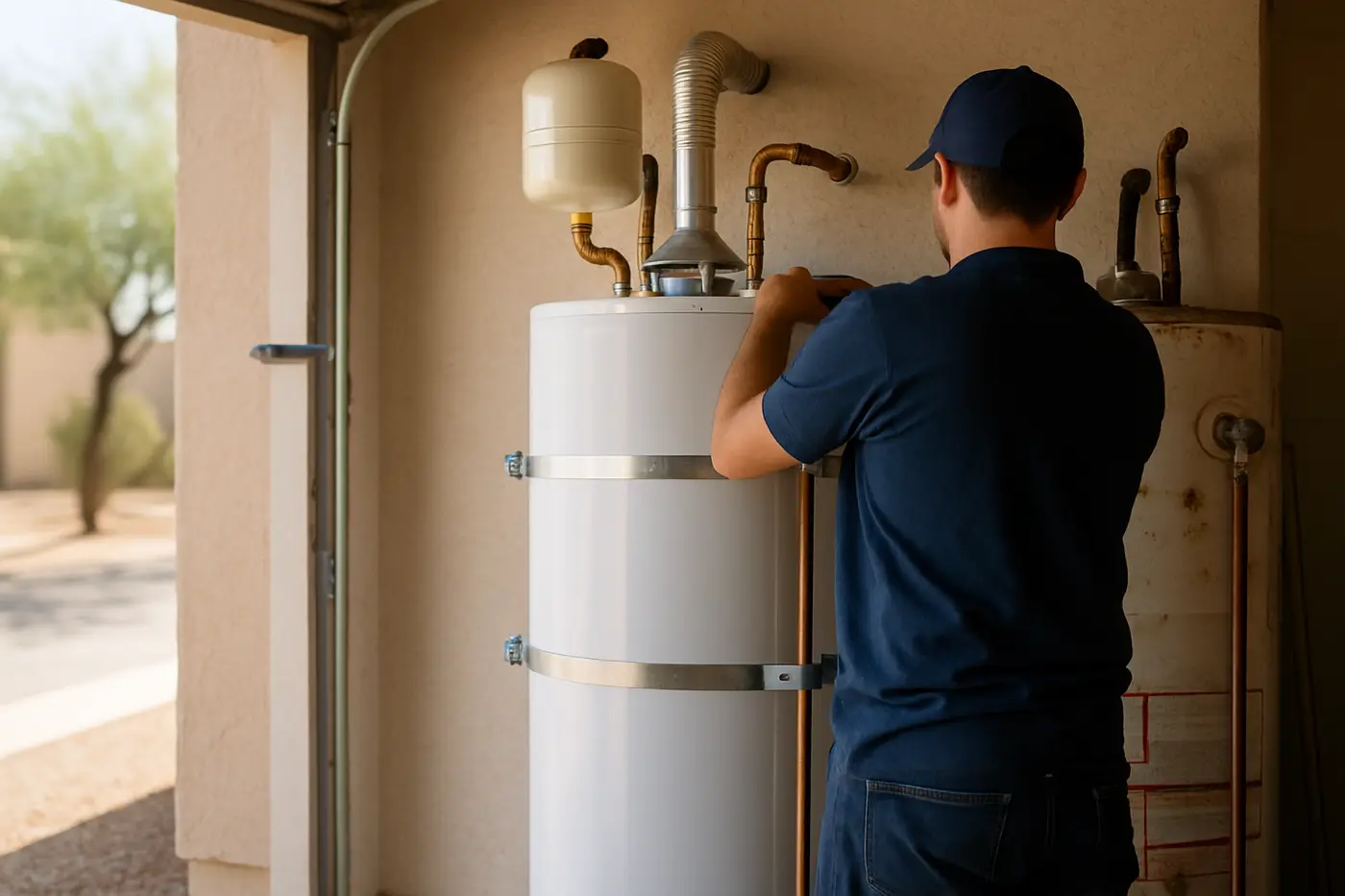
Plumber replacing a tank water heater in a Phoenix garage

Not sure it is urgent?

Send a photo with the form. We will tell you whether it can wait until morning or needs a plumber tonight.

When to call

Signs you needwater heater repair.

Any of the following is worth a call the same day. Water on a slab home has nowhere to drain, so the wet area is nearly always bigger than the stain you can see.

  • Water is leaking from the tank body or seams and spreading across the floor
  • A gas smell near the water heater (leave first, then call the gas utility)
  • The relief valve is discharging steadily, not just dripping
  • No hot water and someone in the home cannot safely go without it
  • Rumbling or popping from the tank along with rusty hot water
  • The pilot will not stay lit or the unit trips its high-limit switch repeatedly
  • The heater is past 10 years old and any of the above has started

Our process

How water heater repairruns, step by step.

From the first call to the last pressure test, you will know what is happening, why, and what it costs at each stage.

  1. Step 1: Make it safe

    On the phone you close the cold water valve on top of the heater and turn the gas control to off or switch the breaker off. If the tank body is leaking, that stops the flood. You then hear whether tonight is worth the dispatch fee or whether the repair can wait for morning.

  2. Step 2: Diagnose the unit and the house

    The plumber checks the tank for rust and weeping seams, the relief valve and expansion tank, the burner or elements and controls, and the house pressure at a hose bib. That last check catches the failed PRV that would otherwise kill the next heater.

  3. Step 3: Repair or replace, in writing

    A sound tank with a failed part is repaired from truck stock. A tank leaking from the body is replaced, with a written price that includes the permit, expansion tank, relief discharge, strapping and pan where required.

  4. Step 4: Test, permit, hand over

    The unit is fired, temperature and pressure are checked and the relief discharge is verified. Replacements are inspected under the permit. You get the paperwork, photos and a plain explanation of what shortened the old unit's life.

Price guide · USD, 2026

What water heater repaircosts in Phoenix.

Typical Phoenix ranges. The final price is quoted on site, in writing, before any work starts. After-hours dispatch is explained on the phone.

ItemTypical range
Water heater repair (element, thermostat, valve, thermocouple) Where the tank itself is sound$150–$700
Tank water heater replacement (40–50 gal) Permit, expansion tank, code upgrades$1,400–$3,500
Tankless water heater installation Gas line and venting upgrades vary$3,000–$6,500
Pressure reducing valve replacement When a failed PRV caused the heater failure$350–$900
Service call / diagnostic (business hours) Credited toward the repair$89–$189
After-hours, weekend or holiday emergency dispatch Explained on the phone before dispatch$150–$350

Ranges cover labor, standard parts and permits where noted, for 2026. The number you approve on the written quote is the number you pay; if the scope changes once walls or slab are opened, we stop and re-quote in writing.

Full price guide

In depth

Water Heater Repair in Phoenix: how the job actually runs.

Water heater repair covers everything from a pilot that will not stay lit to a tank that has split and is running water across the garage floor. In Phoenix, tank water heaters commonly last 8 to 12 years, and hard-water sediment is the main reason they do not last longer. You need emergency water heater service when the tank is leaking from the body, when water is pooling around the base and spreading, or when there is a gas smell near the unit. You need scheduled service, at daytime rates, when there is no hot water but nothing is leaking.

Leaking tank or no hot water: which is the emergency?

Leaking tank body. Once the steel tank itself rusts through, it cannot be repaired, and a 40 or 50 gallon tank on a live supply line will keep putting water on the floor until the cold inlet is closed. Close the cold water valve on top of the heater. Turn the gas control to off, or switch the breaker off for an electric unit. If the heater is in a garage, move anything on the floor. Then call. This is an emergency because the water does not stop on its own.

Leaking from a fitting, valve or the relief valve. A drip from the temperature and pressure relief valve, a supply connection or the drain valve is usually repairable and usually not an emergency once you have closed the cold inlet. It can wait for morning.

No hot water, no leak. A failed thermocouple, a tripped high-limit switch, a dead element or a failed gas valve is inconvenient, not dangerous. Unless someone in the home cannot go without hot water, this is a daytime service call at $89 to $189, not a $150 to $350 after-hours dispatch. We will say so on the phone.

Gas smell near the heater. Leave the building, call the gas utility’s emergency line from outside, then call a licensed plumber for the house-side piping. You can check a contractor’s license with the Arizona Registrar of Contractors. Never relight a pilot when you smell gas.

Why Phoenix water heaters fail early

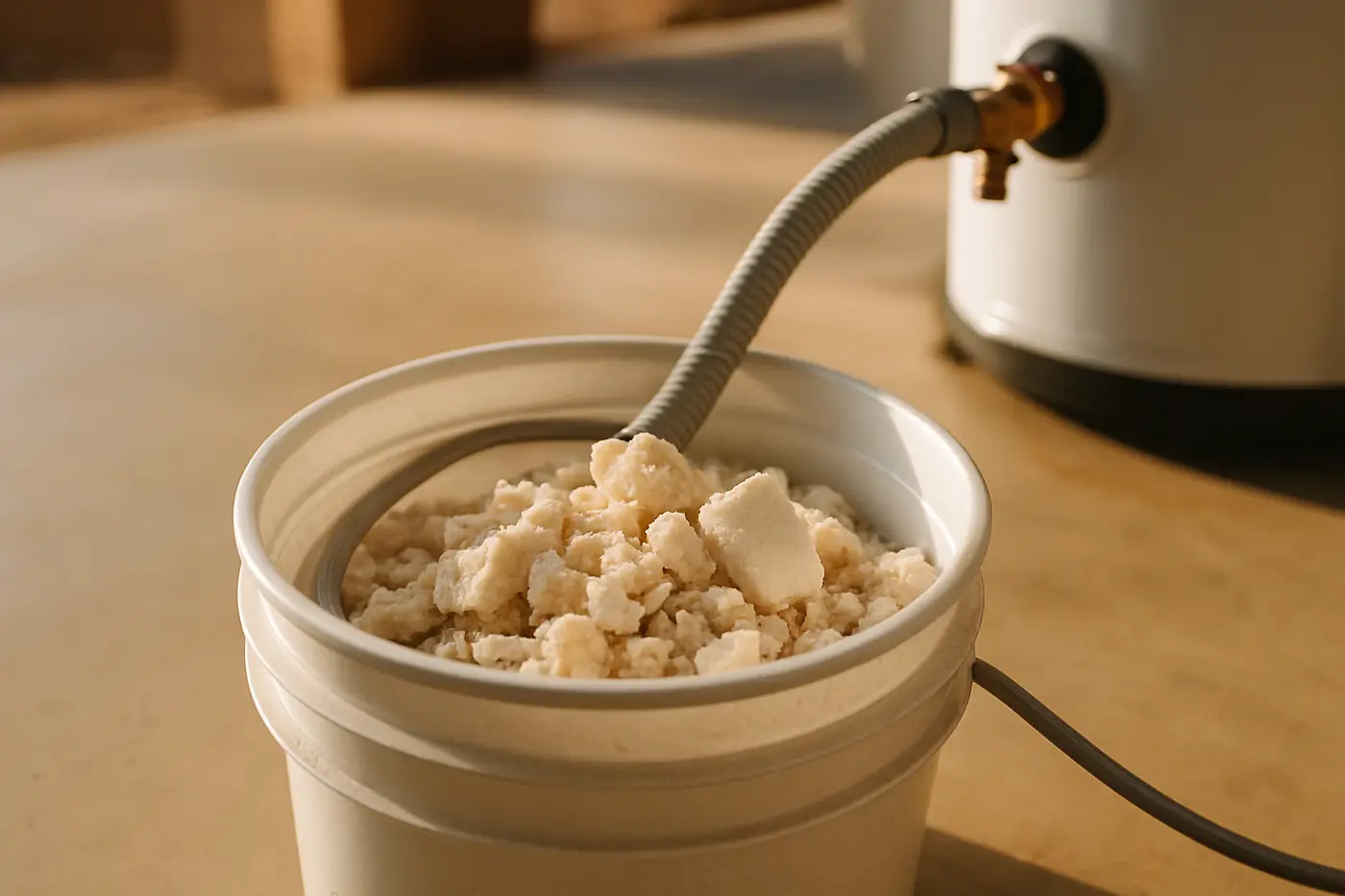
Hard water. Phoenix water runs 10 to 17 grains per gallon, well past the “very hard” threshold of 10.5. Minerals drop out of solution when the water is heated and settle as sediment on the tank bottom. The burner then heats through a layer of rock, the tank bottom overheats, the glass lining cracks and the steel rusts. The rumbling you hear is water boiling through sediment. On electric units the lower element buries itself in scale and burns out. Full detail in why water heaters fail faster in Phoenix.

Heat. Most Phoenix water heaters live in the garage, a utility closet or an outdoor closet. A garage at 110°F or above in July cooks the controls, the gas valve and the anode, and incoming water is already warm, which changes how thermostats and elements cycle.

Pressure and thermal expansion. Many Phoenix zones deliver street pressure above 80 psi. The pressure reducing valve near the main creates a closed system, and a closed system needs a thermal expansion tank; without a working one, every heating cycle spikes pressure and pops the relief valve. A dripping relief valve is more often an expansion or PRV problem than a valve problem. PRVs fail after roughly 10 to 15 years, and a failed PRV bursts water heater fittings.

Age by neighborhood. Desert Ridge and Laveen homes from the late 1990s and 2000s are on their first or second heater, and many are due. Paradise Valley Village subdivisions from the 1970s to 1990s have units well past 12 years. Multi-unit buildings in Biltmore see PRV and heater failures across units, and Estrella homes fight silt and hard water together.

How the repair runs

The plumber confirms the water and fuel are off, then looks at four things: the tank body for rust and weeping seams, the relief valve and expansion tank, the burner or elements and controls, and the house pressure at a hose bib. That last check catches the failed PRV that would otherwise kill the new heater.

Repairs done from truck stock include thermocouples, igniters, gas valves, elements, thermostats, relief valves, drain valves and supply connections, typically $150 to $700. A tank that is leaking from the body is replaced, not repaired.

A replacement in Phoenix means the new tank, a new expansion tank if the system is closed, a new relief valve and discharge line, seismic strapping and a drain pan where required, gas flex and sediment trap or a new electrical whip, and the permit and inspection. $1,400 to $3,500 for a 40 to 50 gallon tank. Tankless conversion runs $3,000 to $6,500 because the gas line and venting are usually upsized. Neither is a same-night job unless the plumber happens to have the right unit on the truck; a leaking tank is shut down and made safe, and the replacement is scheduled at daytime rates.

Repair or replace?

SituationRepairReplace
Leaking from the tank body or seamsYes, no repair exists
Under 8 years, failed thermocouple, element or thermostatYes, $150–$700
Relief valve drippingCheck the expansion tank and PRV first
Over 10 years, second repair in a yearPossibleUsually the better money
Rumbling, rusty hot water, slow recoveryA flush may help if the unit is youngLikely; sediment has done its work
Gas valve failure on a 12-year-old unitYes

What it costs

Typical Phoenix ranges, final price quoted on site in writing before work starts. Repair of an element, thermostat, valve or thermocouple: $150 to $700. Tank replacement, 40 to 50 gallon, with permit, expansion tank and code upgrades: $1,400 to $3,500. Tankless installation: $3,000 to $6,500. Pressure reducing valve replacement when the PRV caused the failure: $350 to $900. A business-hours service call is $89 to $189, credited toward the repair; after-hours dispatch is $150 to $350. The emergency plumber cost guide puts these next to the rest of the trade.

Permits and insurance

Water heater replacement requires a permit from the City of Phoenix Planning and Development Department or the equivalent department in Scottsdale, Tempe, Mesa, Paradise Valley or Tolleson, with an inspection. Phoenix follows the International Plumbing Code with local amendments, and the inspector will look for the expansion tank, the relief discharge, strapping and the drain pan. A replacement without a permit is what the cheap ad is selling. Standard Arizona homeowners policies (HO-3) cover the sudden water discharge from a ruptured tank and the damage to the garage or closet, but not the heater itself. Photos and the plumber’s written report help the claim.

A water heater that is leaking at a fitting is often the first visible symptom of a failed PRV, and the same over-pressure that split the fitting is stressing every supply hose in the house. Our burst pipe repair page explains that chain. A gas water heater with a suspected gas leak at the flex or valve is a gas line repair first, and the utility gets the call before we do.

If the tank is leaking now, close the cold inlet, shut the gas or breaker, and then call or send the form. If it is just cold water in the shower, tell us that too, and we will book the cheaper daytime slot.

Last updated August 25, 2026
Ask questions

Water Heater Repair, explained.

Straight answers about response times, after-hours pricing, permits and what to expect from water heater repair in Phoenix.

All questions
The water heater is leaking. What do I do right now?

Find where the water is coming from. If it is running from the tank body or seams, close the cold water valve on top of the heater, turn the gas control to off or switch the breaker off for an electric unit, and move anything off the garage or closet floor. That tank cannot be repaired and will keep leaking until the water is off. If the drip is from the relief valve, a supply fitting or the drain valve, closing the cold inlet stops it and the repair can usually wait for a daytime visit. Take photos before anything is cleaned up.

Is no hot water an emergency?

Usually not. A failed thermocouple, a dead heating element, a tripped high-limit switch or a failed gas valve leaves you with cold water but nothing leaking and nothing dangerous. That is a daytime service call at $89 to $189, credited toward the repair, rather than a $150 to $350 after-hours dispatch for the same fix. It becomes an emergency if the unit is also leaking, if there is a gas smell, or if someone in the home cannot safely go without hot water. Tell us the situation on the phone and you will get a straight answer.

Why do water heaters wear out faster in Phoenix?

Two reasons. First, hard water: Phoenix municipal water runs 10 to 17 grains per gallon, and heating it drops minerals out as sediment on the tank bottom. The burner then heats through rock, the tank bottom overheats, the lining cracks and the steel rusts; on electric units the lower element buries itself in scale. Second, heat: most heaters sit in garages or outdoor closets that reach 110°F or more in summer, which cooks controls and the anode rod. Tank units here commonly last 8 to 12 years. Annual flushing and a working expansion tank help.

The relief valve keeps dripping. Is the valve bad?

Sometimes, but more often it is doing its job. Phoenix homes have a pressure reducing valve at the main, which makes the plumbing a closed system. When the heater fires, the water expands and, with nowhere to go, pressure spikes until the relief valve opens. A working thermal expansion tank absorbs that spike, and one is required with a closed system. So a dripping relief valve usually means a waterlogged or missing expansion tank, or a PRV that has failed and is letting street pressure above 80 psi into the house. The plumber checks pressure before replacing the valve.

Do I need a permit to replace a water heater?

Yes. Water heater replacement requires a permit from the City of Phoenix Planning and Development Department, or the equivalent department in Scottsdale, Tempe, Mesa, Paradise Valley or Tolleson, followed by an inspection. Phoenix follows the International Plumbing Code with local amendments, and the inspector checks the expansion tank, the relief valve discharge line, seismic strapping, the drain pan where required, and the gas or electrical connection. The permit is included in the $1,400 to $3,500 replacement range. A cheap replacement with no permit is usually an unlicensed operator working under the handyman exemption, and it can complicate a later insurance claim or home sale.

Should I switch to tankless?

It depends on the house more than the heater. Tankless units save space and do not store 50 gallons that can leak, but in Phoenix the very hard water scales their heat exchangers quickly, so a softener or regular descaling is part of the deal. Installation runs $3,000 to $6,500 because the gas line and venting usually need upsizing and the permit covers both. If your existing gas line is small, the garage is far from the bathrooms, or you are replacing a tank in an emergency, a like-for-like tank at $1,400 to $3,500 is the simpler, faster choice.

Will insurance cover a ruptured water heater?

Standard Arizona homeowners policies (HO-3) cover sudden and accidental water discharge, and a tank that has split and flooded a garage, closet or adjacent rooms qualifies. The policy pays for the resulting damage to flooring, drywall and contents, not for the water heater itself, which is treated as a worn-out appliance. Gradual weeping that went unnoticed for months can be contested. Photograph the unit and the water before cleanup, keep the failed heater until the adjuster has seen it or released it, and get the plumber's written report describing the failure.

Related services

Helpful reading

Guides that go withthis service.

Practical, Phoenix-specific reading on shut-offs, costs, slab leaks, polybutylene and monsoon season.

Emergency Plumbing

Water Heater Repair across Phoenix, any hour. Tell us what is happening and get the price and an honest arrival window before anyone is dispatched.

(602) 854-9980
Plumber's van driving through a Phoenix neighborhood with Camelback Mountain in the background