In depth
Sewer Line Repair in Phoenix: how the job actually runs.
The sewer line, or lateral, is the single drain pipe that carries everything from your house to the city main under the street. In Phoenix the property owner owns that pipe from the house all the way to the main, and the city owns the main. Sewer line repair is what happens when clearing the line is no longer enough: roots keep coming back, a section has collapsed, or the pipe has sagged into a belly that holds waste. The emergency version is sewage backing up into the house; the scheduled version is a camera showing a problem that will become that emergency.
Emergency or scheduled?
A backup into a tub, shower or floor drain is an emergency. Sewage is a health hazard however clear it looks, and every flush upstairs makes it worse. The immediate work is clearing the line so the house drains, which is emergency drain cleaning at $250 to $700 through the cleanout, at any hour.
The repair itself is almost never done at 2 a.m. Excavation, permits, locating other utilities and a trenchless crew are daytime work. So an emergency sewer call usually runs in two parts: restore flow tonight, camera the line, then quote the repair in writing for a scheduled day. If the line cannot be cleared because it has collapsed, the honest advice is to stop using water in the house, arrange somewhere to shower, and get the repair scheduled fast.
What Phoenix sewer lines are made of
Clay. The standard lateral in pre-1960 homes across Willo, Coronado, Uptown Phoenix, Sunnyslope and Maryvale. Clay pipe itself lasts, but the joints every few feet separate as the ground moves, and every open joint is a door for roots.
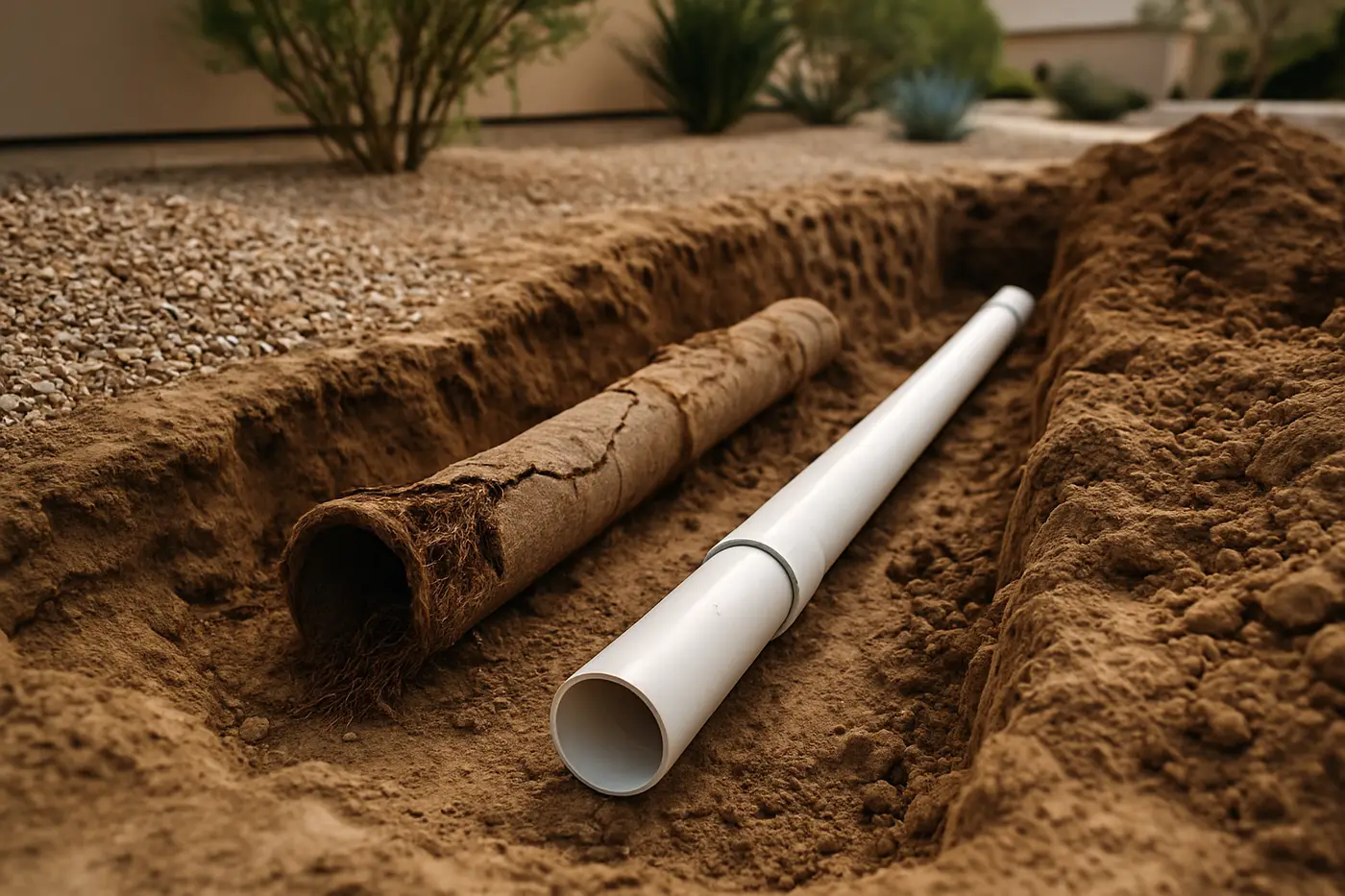
Orangeburg. Bituminous fiber pipe, essentially tar-impregnated paper, used in many mid-century homes. It softens, deforms into an oval, blisters inside and eventually collapses. A camera shows the telltale flattened profile. Orangeburg is not repaired; it is replaced.
Cast iron. Common under the slab and in stacks in older homes and multi-unit buildings. It scales and rusts inside until the bore narrows, and the bottom of horizontal runs rots through.
ABS and PVC. Homes from the 1970s on. Fewer material failures, but bellies from poor bedding, crushed sections under driveways, and joints pulled apart by tree roots still happen.
Roots, soil and slope
Phoenix trees are aggressive about water. Ficus, mulberry, mesquite, palo verde and palms send roots into any joint that leaks moisture, and on flood irrigation lots in Arcadia, Laveen and parts of Central Phoenix the soil stays wet and the trees stay hungry. A root mass at a joint catches paper and grease, backs the line up, gets cut out with a cable, and grows back in months.
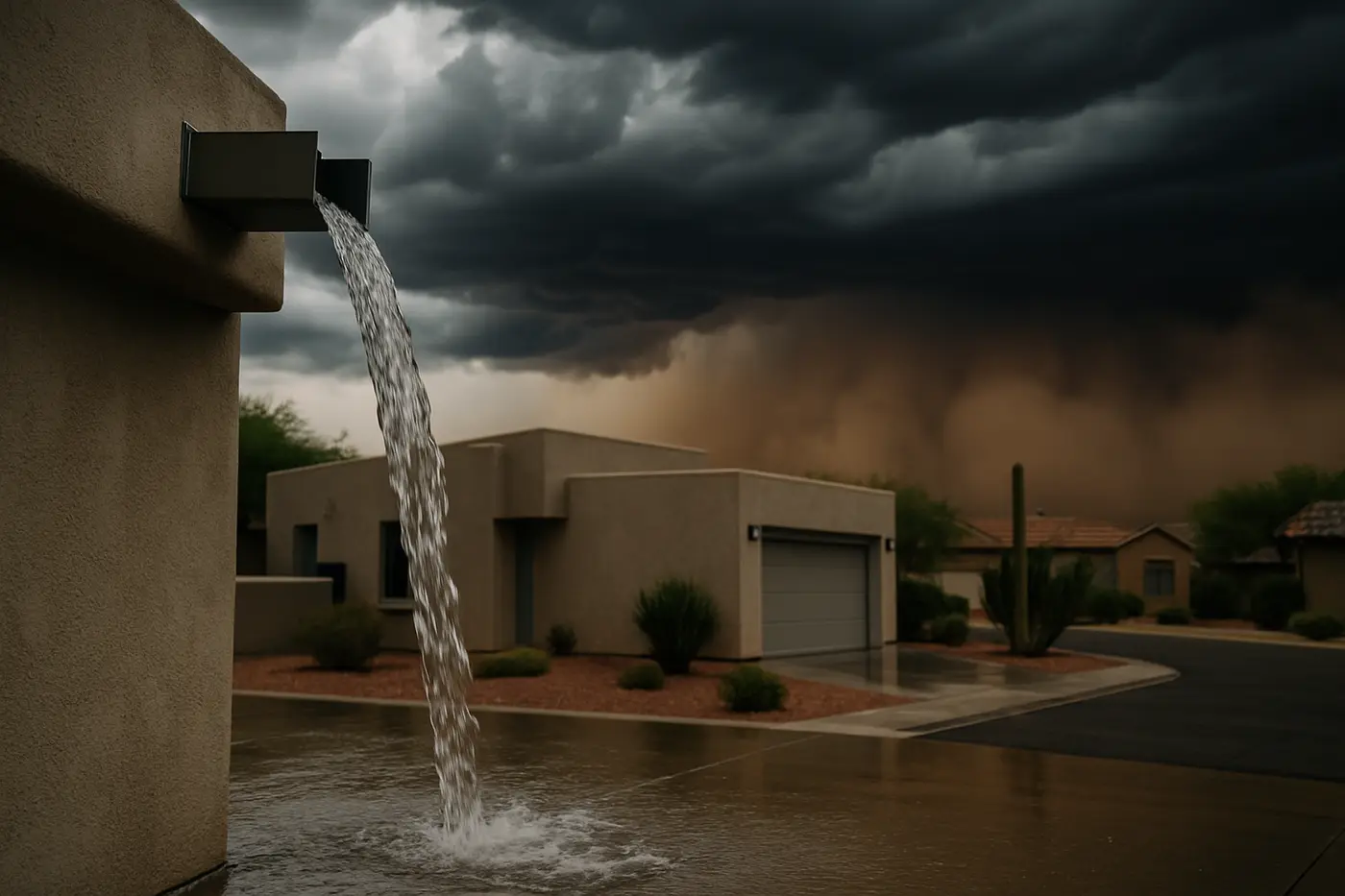
Hillside lots in Sunnyslope run their laterals down slopes at steep grades, which is fine for flow and hard on joints. Flat lots in Maryvale and Alhambra have long shallow runs that sag into bellies. Monsoon downpours between June 15 and September 30 surcharge the whole system and find every weak spot at once.
How the diagnosis and repair run
Clear and camera. After flow is restored, a camera goes through the cleanout and records the full run to the main. You see roots at a joint, a belly holding water, scale, an offset, or a collapse, with distance and depth markers. $200 to $500, often credited toward the repair. Nobody should quote a sewer repair without a camera, and you should get a copy of the video.
Locate. A sonde on the camera head marks the problem on the surface and gives depth, so excavation is one hole in the right place, not a trench of guesses.
Spot repair. The section is excavated, cut out and replaced with PVC on proper couplings, bedded and backfilled. Right for a single root intrusion, one crushed section or one offset joint in an otherwise sound line. $1,500 to $5,000 depending on depth and what is above it: dirt is cheap, a driveway or a mature tree is not.
Replacement. When a camera shows Orangeburg, multiple failures, or a line that is scaled or bellied along most of its length, the whole lateral is replaced. Open trench digs the run and lays new PVC. Trenchless pipe bursting pulls a new HDPE pipe through the old one from two pits, leaving the yard mostly intact. Both need a permit and a locate of other utilities. $5,000 to $20,000 or more, driven by length, depth, method and surface restoration.
| Option | Yard disturbance | Typical cost | When it fits |
|---|---|---|---|
| Cable clearing | None | $250–$700 | Restore flow now |
| Hydro jetting | None | $400–$900 | Grease, scale, root mass |
| Camera inspection | None | $200–$500 | Before any repair decision |
| Spot repair | One excavation | $1,500–$5,000 | Single bad joint or crushed section |
| Open-trench replacement | Full run | $5,000–$20,000+ | Orangeburg, multiple failures, shallow line |
| Trenchless replacement | Two pits | $5,000–$20,000+ | Deep line, driveway, hardscape or mature trees above |
The homeowner owns the lateral
In Phoenix, the City of Phoenix Water Services Department owns the main under the street and the customer owns the lateral from the house to the main, including the part under the sidewalk and the street. Scottsdale, Tempe, Mesa and other Valley cities run their own utilities on the same principle. The practical result is that a collapse under the sidewalk is your repair and needs a right-of-way permit as well as the plumbing permit. If a backup happens during a storm and neighbors have it too, the main may be surcharging, and that is the utility’s problem; report it to them as well.
Permits and insurance
Sewer line replacement requires a permit from the City of Phoenix Planning and Development Department or the equivalent department in Scottsdale, Tempe, Mesa, Paradise Valley or Tolleson, plus inspection before backfill. A licensed Arizona plumber pulls it; the permit is included in the written price. Standard Arizona homeowners policies (HO-3) generally do not cover the sewer lateral repair itself, and cover sewage backup damage inside the house only if you carry a backup endorsement. Some carriers offer service line coverage as an add-on. Ask before the work, and keep the camera video and the written report.
Cheap sewer quotes deserve scrutiny. Arizona’s handyman exemption covers work under $1,000 that needs no permit, and sewer replacement is neither. License status and complaint history are searchable at the Arizona Registrar of Contractors. Verify any contractor at azroc.gov; see what to check before you book a cheap emergency plumber.
Before the plumber arrives
Stop running water. Keep people and pets away from anything that came up. Do not open the outside cleanout cap yourself if it is under pressure. Note which fixtures backed up and when, and whether neighbors have the same problem, especially during a monsoon storm. If a single toilet is the only thing misbehaving and the tub drains fine, start with toilet repair instead; that is not a sewer problem yet. Then call or send the form. You will get an honest window for restoring flow tonight and a camera-based written quote for whatever comes after.
Last updated September 14, 2026