Skip to content

Emergency plumbing · Phoenix & the Valley

Gas Line Repair Phoenix

If you smell gas: leave the building, call the gas utility's emergency line from outside, then call us. Licensed Arizona plumbers pressure test, locate and repair house-side gas piping across Phoenix, with the permit and inspection that gets your gas turned back on.

  • 24/7 Dispatch
  • Licensed plumbers
  • Written Quote
  • Honest ETAs
  • Homes & Business

Schedule Gas Line Repair

24/7 dispatch
US format - we will call or text you back right away.
Add a short message (optional)
How urgent?

Written quote before any work starts. No obligation. Privacy.

Emergency or scheduled?

We tell you on the phone whether this needs a plumber tonight or can wait for the daytime rate.

Written quote first

The price goes on paper before any work starts. If walls have to open, we stop and re-quote.

What's included

Everything the job needs,scoped before we start.

Every gas line repair job in Phoenix includes the work below as standard. It is written into the quote before we start, so there are no surprise extras on the invoice.

  • Clear instructions on the phone: leave, utility first, plumber second
  • Pressure testing of the house piping isolated from the meter and appliances
  • Leak location with an electronic combustible gas detector and leak solution, branch by branch
  • Repair of threaded black iron joints, corroded sections, CSST and appliance connectors
  • New gas runs for ranges, dryers, pool heaters, fire pits and tankless water heaters, sized to the house load
  • Permit and inspection through the city so the utility restores service
  • Appliance relight and check once gas is back on
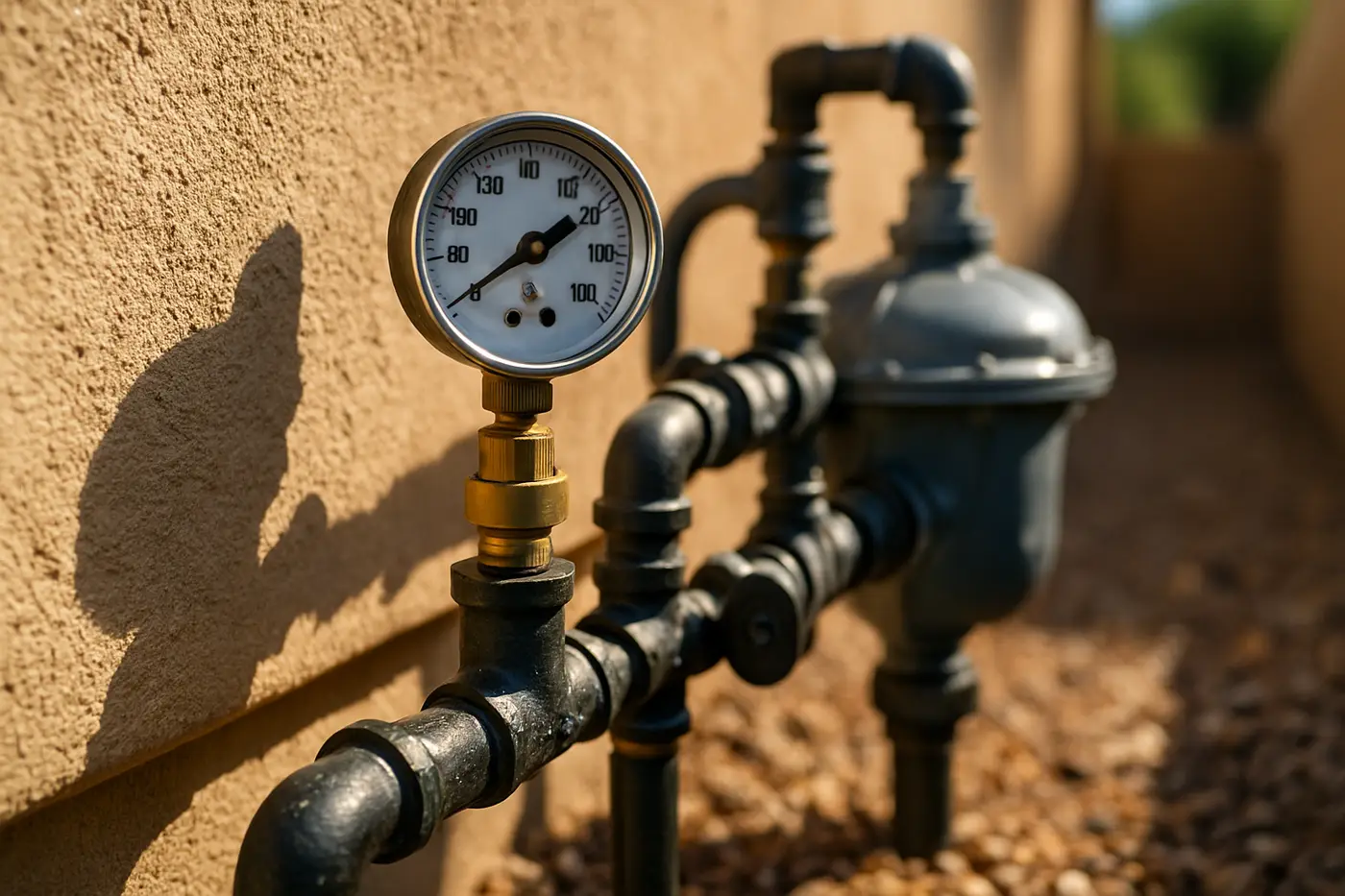
Plumber pressure-testing a gas line at the meter outside a Phoenix home

Not sure it is urgent?

Send a photo with the form. We will tell you whether it can wait until morning or needs a plumber tonight.

When to call

Signs you needgas line repair.

Any of the following is worth a call the same day. Water on a slab home has nowhere to drain, so the wet area is nearly always bigger than the stain you can see.

  • You smelled gas and the utility has shut off the meter; the house side now needs repair
  • The utility found a leak on your side of the meter and tagged it
  • A gas appliance was moved or replaced and there is a faint smell at the connector
  • Hissing at a valve, connector or outdoor line to a pool heater or barbecue
  • Dead or dying vegetation in a line over a buried gas run
  • A remodel or inspection uncovered gas piping that was never permitted
  • You want a new gas line for a range, dryer, fire pit or tankless heater

Our process

How gas line repairruns, step by step.

From the first call to the last pressure test, you will know what is happening, why, and what it costs at each stage.

  1. Step 1: Utility first, then us

    For a gas smell, you leave and call the gas utility's emergency line; they shut off the meter and make the property safe. Once that is done, you call us and we give you an honest window for the test, the repair and the inspection, in that order.

  2. Step 2: Pressure test and locate

    The house piping is isolated and pressurized with air, then watched on a gauge. A drop means a leak. Branches are tested one at a time and every joint, valve and connector is checked with an electronic detector and leak solution until the leak is found.

  3. Step 3: Repair and retest

    The leaking joint is remade, the corroded or damaged section replaced, old connectors replaced with new ones rated for the appliance. The system is tested again and held for the inspector. The price was in writing before any of this started.

  4. Step 4: Permit, inspection, gas on

    Gas work requires a city permit and inspection. After the inspection passes, the utility restores service at the meter and the plumber relights and checks each appliance. You get the permit paperwork and a written report.

Price guide · USD, 2026

What gas line repaircosts in Phoenix.

Typical Phoenix ranges. The final price is quoted on site, in writing, before any work starts. After-hours dispatch is explained on the phone.

ItemTypical range
Gas leak detection and repair Pressure test, permit$300–$1,500
Gas line run for appliance Range, dryer, pool heater, fire pit, tankless$500–$2,000
Water heater repair (gas valve, thermocouple) When the fault is in the appliance, not the line$150–$700
Tankless water heater installation Gas line and venting upgrades vary$3,000–$6,500
Service call / diagnostic (business hours) Credited toward the repair$89–$189
After-hours, weekend or holiday emergency dispatch Rarely useful for gas once the utility has shut off the meter$150–$350

Ranges cover labor, standard parts and permits where noted, for 2026. The number you approve on the written quote is the number you pay; if the scope changes once walls or slab are opened, we stop and re-quote in writing.

Full price guide

In depth

Gas Line Repair in Phoenix: how the job actually runs.

Gas line repair is the house-side work after a gas leak: finding where the piping, fittings or appliance connectors are leaking, fixing or replacing them, pressure testing the system, and getting the permit closed so the utility will restore service. It is also the work of running a new line for a range, a dryer, a pool heater, a fire pit or a tankless water heater. The emergency is the smell of gas. The repair is what happens afterward, in daylight, by a licensed plumber, with a permit.

If you smell gas, do this first

Leave the building. Do not flip light switches, do not use anything with a spark, do not start a car in an attached garage, and do not go looking for the leak. From outside, call the gas utility’s emergency line; Southwest Gas serves most of the Phoenix area. The utility will shut off gas at the meter and make the property safe. Then call a licensed plumber for the house-side piping, because the utility’s responsibility ends at the meter and everything downstream is the owner’s.

That order matters and we will repeat it on the phone. A plumber does not respond to a gas smell as the first call; the utility does. A plumber responds once the gas is off and the question is what failed and how to fix it.

Where gas lines fail in Phoenix

Appliance connectors and valves. The flexible connector behind a range or dryer, the flex at a water heater, and the shut-off valves that feed them are the most common leak points, especially after an appliance has been moved or replaced by someone who reused the old connector. Water heaters in garages and outdoor closets that run above 110°F in summer cook their gas valves; see water heater repair.

Threaded joints in black iron. House piping is usually black steel with threaded joints. Joints that were poorly sealed when installed, or that have been stressed by settling, leak slowly. Outdoor runs to pool heaters, barbecues and fire pits corrode where they enter the ground or pass through stucco.

Corrosion and damage underground. Buried steel lines to pool heaters and outdoor kitchens corrode from the outside, and irrigation work, tree roots and monsoon runoff do the rest. Large lots in Moon Valley and the acre estates in Paradise Valley have long runs to pool and spa heaters and detached structures. Remodels and additions in Arcadia frequently uncover gas lines that were extended without a permit.

Flexible stainless (CSST). Yellow-jacketed corrugated stainless tubing in newer homes. It needs proper bonding and protection where it passes through framing; damage from a nail or a screw during later work is a classic leak.

Meter and regulator. Those are the utility’s and are not house-side work.

How the repair runs

Confirm the gas is off and the property is safe. This is the utility’s job and it comes first. If the utility has tagged the meter, the plumber works with that tag.

Pressure test. The house piping is isolated from the appliances and the meter, pressurized with air and watched on a gauge for decay. A system that holds is sound; a system that drops has a leak, and the test also tells the plumber how big.

Locate. Every joint, valve and connector is checked with an electronic combustible gas detector and leak solution. Underground and inside-wall sections are isolated and tested one branch at a time to narrow the location before anything is opened.

Repair. A leaking joint is remade with new fittings and proper sealant. A corroded section is cut out and replaced. Old flexible connectors are replaced with new ones rated for the appliance and never reused. Damaged CSST is replaced and bonded. Underground steel is replaced with material and coating rated for burial, or rerouted above grade where practical.

Retest, permit, inspection, restore. The system is pressure tested again and held for the inspector. Gas line work requires a permit from the City of Phoenix Planning and Development Department or the equivalent department in Scottsdale, Tempe, Mesa, Paradise Valley or Tolleson. After the inspection passes, the utility restores service at the meter and the plumber relights and checks each appliance.

Because of the permit and inspection sequence, gas line repair is rarely finished the night the leak is found. The honest timeline is: utility makes it safe today, plumber tests and locates and repairs, inspection, then gas back on. In the meantime, a gas water heater means cold showers, and we will tell you so up front.

New gas runs

A new line for a range, dryer, outdoor kitchen, fire pit, pool heater or tankless water heater is sized from the total load on the house, run in black iron or CSST, pressure tested and permitted the same way. $500 to $2,000 depending on length and route. A tankless conversion often needs the main gas line upsized, which is part of why tankless installation runs $3,000 to $6,500. Commercial kitchens and restaurant equipment in Downtown Phoenix and the warehouse districts in Deer Valley have their own sizing and code requirements; see commercial emergency plumbing.

What it costs

Typical Phoenix ranges, final price quoted on site in writing before work starts. Gas leak detection and repair, including the pressure test and permit: $300 to $1,500. New gas line run for an appliance: $500 to $2,000. Water heater gas valve or thermocouple repair: $150 to $700. A business-hours service call is $89 to $189, credited toward the repair; after-hours dispatch is $150 to $350, and for gas it is worth asking whether anything can happen tonight that the utility has not already done.

Who should touch a gas line

Only a licensed Arizona plumber or gas contractor, with a permit. Arizona’s handyman exemption covers work under $1,000 that does not require a permit, and gas work always requires a permit, so any unlicensed operator offering gas repairs is outside the law regardless of the price. Verify the license at azroc.gov; ours is available on request. What to check before you book a cheap emergency plumber covers the questions. And never, for any reason, attempt to find a gas leak with a flame, tape over a leak, or reconnect an appliance the utility disconnected.

The house-side line, summarized

WhereWho owns itWho responds firstTypical fix
Meter and regulatorGas utilityUtilityUtility work
Piping from meter to appliancesProperty ownerUtility shuts off, then plumberPressure test, locate, repair, permit
Appliance connectors and valvesProperty ownerPlumber after utilityReplace connector and valve
Buried run to pool heater or outdoor kitchenProperty ownerPlumber after utilityReplace or reroute, permit
Inside the applianceProperty ownerAppliance technician or plumberGas valve, thermocouple, burner

If you smell gas right now, stop reading, leave the building and call the utility from outside. Once the gas is off and the property is safe, call or send the form and you will get an honest window for the test, the repair and the inspection, in that order. The emergency plumber cost guide explains where gas work sits against the rest of the trade.

Last updated August 31, 2026

Ask questions

Gas Line Repair, explained.

Straight answers about response times, after-hours pricing, permits and what to expect from gas line repair in Phoenix.

All questions
I smell gas. Do I call you or the gas company?

The gas utility first, from outside the building. Leave without flipping switches or using anything that sparks, then call the utility's emergency line; Southwest Gas serves most of the Phoenix area. They shut off gas at the meter and make the property safe, at any hour. Then call a licensed plumber, because the utility's responsibility ends at the meter and the piping, valves and connectors on the house side are the owner's to repair. A plumber cannot legally or safely do anything useful while gas is still flowing into an unlocated leak.

How long will the gas be off?

Longer than a water repair, and it is better to know that up front. After the utility shuts off the meter, the plumber pressure tests the house piping, locates the leak, repairs it and retests. Gas line work requires a permit and an inspection from the City of Phoenix Planning and Development Department or the equivalent Valley department, and the utility restores service only after the inspection passes. Depending on scheduling that can be a day or several. A gas water heater means cold showers in the meantime; plan for it and ask about the timeline on the first call.

Where do gas leaks usually happen in a house?

At the connections, not in the middle of a pipe. The flexible connector and shut-off valve behind a range, dryer or water heater lead the list, especially when an old connector was reused on a new appliance. Threaded joints in black iron piping leak slowly if they were poorly sealed or have been stressed. Outdoor runs to pool heaters, barbecues and fire pits corrode where they enter the ground or pass through stucco, and buried steel corrodes from the outside. CSST damaged by a nail during later work is another classic. An electronic detector and leak solution find all of these.

What does a gas line repair cost in Phoenix?

Gas leak detection and repair, including the pressure test and the permit, typically runs $300 to $1,500 depending on where the leak is and how much piping is replaced. A new gas line run for an appliance is $500 to $2,000 depending on length and route. Water heater gas valve or thermocouple repairs are $150 to $700. A business-hours service call is $89 to $189, credited toward the work. Because the utility has already made the property safe and the permit process is a daytime one, paying the $150 to $350 after-hours dispatch for gas work rarely buys you anything.

Can a handyman fix a gas line?

No. Arizona's handyman exemption allows unlicensed work under $1,000 only when the job does not require a permit, and gas line work always requires a permit and inspection. Anyone offering unpermitted gas repair is working outside the law, and the utility will not restore service without a passed inspection anyway. Use a licensed Arizona plumber or gas contractor, verify the license at azroc.gov, and expect a written price and a permit number. The plumber we put you in touch with gives you their ROC license number on request. Cheap gas work is the most expensive kind when it fails.

Do I need a permit to add a gas line for a range or fire pit?

Yes. Any new gas piping in Phoenix requires a permit from the City of Phoenix Planning and Development Department, or the equivalent department in Scottsdale, Tempe, Mesa, Paradise Valley or Tolleson, and an inspection before the line is put into service. The plumber sizes the new run against the total load on the house so existing appliances are not starved, pressure tests the system, and holds the test for the inspector. The permit is included in the $500 to $2,000 range for an appliance run. Unpermitted lines uncovered during a later remodel or home sale have to be redone.

Is a gas water heater problem a gas line problem?

Not usually. No hot water with no gas smell points to the thermocouple, igniter or gas control valve on the heater itself, which is a $150 to $700 water heater repair. A gas smell at the water heater is different: leave, call the utility, then a plumber, who checks the flex connector, the shut-off valve and the appliance valve. Phoenix garages and outdoor closets run above 110°F in summer and shorten the life of those components. A tankless conversion is where gas line work and water heater work overlap, because the supply line is usually upsized.

Related services

Helpful reading

Guides that go withthis service.

Practical, Phoenix-specific reading on shut-offs, costs, slab leaks, polybutylene and monsoon season.

Emergency Plumbing

Gas Line Repair across Phoenix, any hour. Tell us what is happening and get the price and an honest arrival window before anyone is dispatched.

(602) 854-9980
Plumber's van driving through a Phoenix neighborhood with Camelback Mountain in the background