In depth
Commercial Emergency Plumber in Phoenix: how the job actually runs.
Commercial emergency plumbing is the same trade as residential with different stakes. A restaurant kitchen line down at 7 p.m. on a Friday is lost revenue by the hour. A backed-up restroom in an office building is a tenant complaint and a health issue. A failed water heater in a salon or a burst line in a warehouse breakroom stops work. This page covers how emergency response works for Phoenix businesses and property managers: who can authorize, what gets fixed tonight, what gets scheduled, and what it costs.
Who we work with
Restaurants and bars in Downtown Phoenix, Roosevelt Row and Old Town Scottsdale, where grease is the constant enemy. Warehouses and distribution buildings in Deer Valley, Central City South near Sky Harbor, and Tolleson, with long drain runs, few fixtures per square foot and backflow assemblies on the fire and irrigation lines. Offices and medical buildings along the Central Avenue corridor. Retail centers with shared sewer laterals and one grease interceptor for six tenants. Apartment complexes and condo towers where a leak on the ninth floor is a claim on the eighth, seventh and sixth. Salons, gyms, schools, churches and car washes.
What counts as a commercial emergency
Call now if a drain line is backing up during business hours or before opening, if a restroom is out of service and it is the only one, if water is running and the shut-off is unknown or inaccessible, if a water heater is leaking in a mechanical room, if a backflow assembly has split and is spraying, or if there is a gas smell, in which case the building is evacuated and the gas utility called first.
Some things can wait for the next business day and the lower service call rate: one slow sink among several, a running urinal that can be valved off, a dripping mop sink faucet, a water heater that is slow but working, a floor drain smell that a bucket of water will fix. We will tell you which on the phone. Commercial accounts pay the same after-hours dispatch fee as anyone else, $150 to $350, and there is no reason to spend it on a problem that will be exactly the same size at 8 a.m.
Access and authorization
Commercial calls fail on paperwork more than on plumbing. Before the plumber rolls we need three things: who is authorizing the work and up to what amount, who has keys and alarm codes for the mechanical room, roof and cleanouts, and whether the building has a preferred vendor or insurance requirement we need to know about. Property managers who set this up in advance get a faster response than anyone else, because the plumber goes straight to work. If a landlord and tenant disagree about who pays, the plumber stops the water and waits; that is not a fight to have in a flooding kitchen.
The Phoenix commercial failures we see most
Grease. Restaurant kitchen lines, floor sinks and grease interceptors. Interceptors that are not pumped on schedule pass grease downstream, where it cools and coats the lateral. A cable punches a hole through it; only hydro jetting scours it off the wall. Shared laterals in retail centers mean one tenant’s grease backs up the tenant next door.
Cast iron stacks in older buildings. Mid-century buildings downtown and in Midtown have cast iron stacks scaled to a fraction of their bore. Restroom stacks back up on the lowest floor first.
Backflow assemblies. Commercial properties and irrigation systems in Phoenix and most Valley cities must have their backflow prevention assemblies tested annually by a certified tester. Assemblies split in the rare hard freeze, as they did across the Valley in early February 2011, and debris from monsoon storms damages them. A failed test means a repair before the utility’s deadline.
Water heaters and boilers. Commercial heaters run hard on very hard water, 10 to 17 grains per gallon, and sediment shortens their life. Mechanical rooms with no floor drain flood.
Pressure. Street pressure above 80 psi in many zones, PRVs on the service, and thermal expansion; the same physics as a house, scaled up.
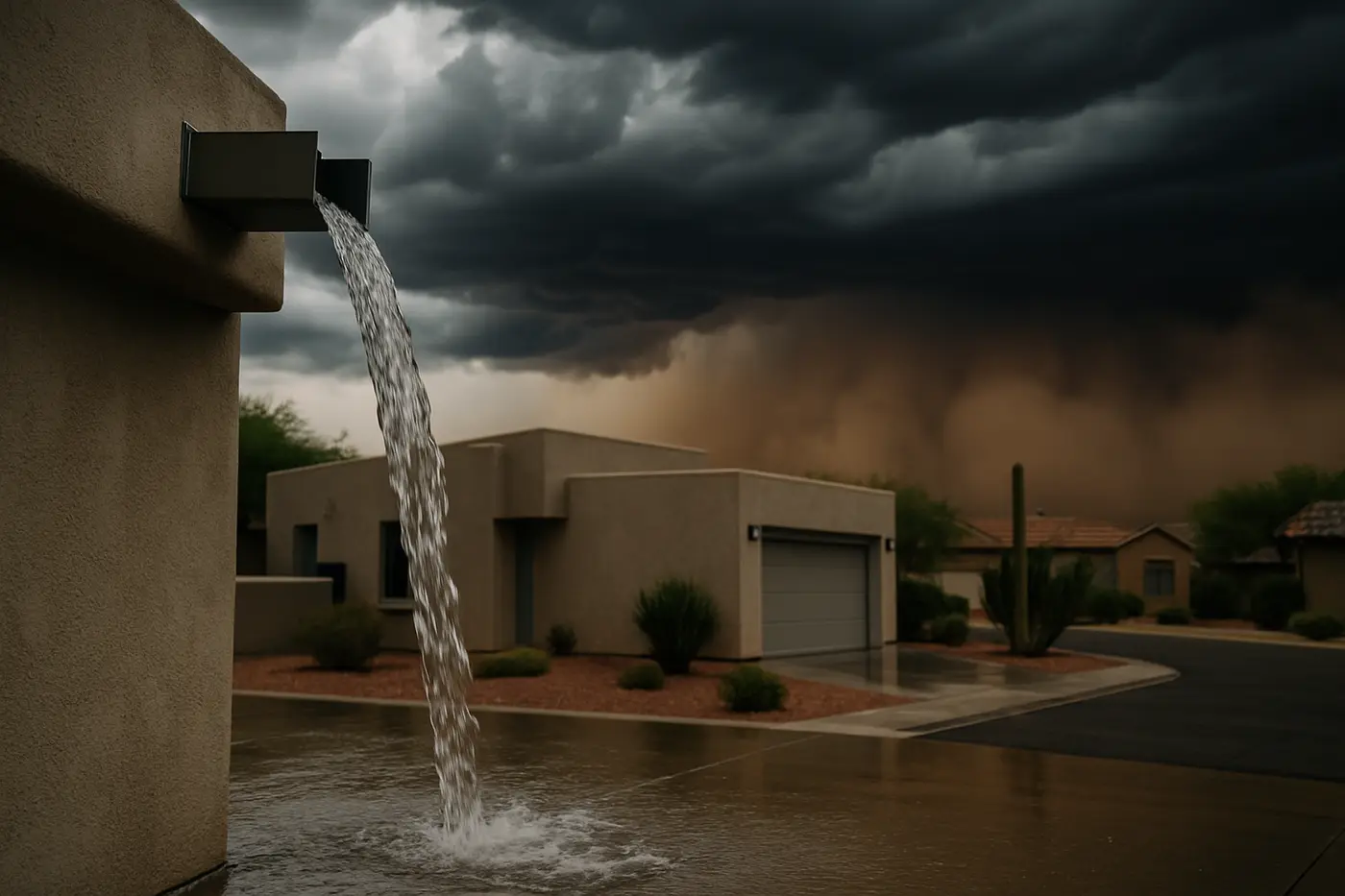
Monsoon. June 15 to September 30. Roof drains and scuppers on flat commercial roofs clog with debris and pond water; parking lot drains and sewer laterals surcharge; storm water enters loading docks and below-grade rooms; sewage ejector pumps in the few basements are overwhelmed. Monsoon season plumbing problems covers the pre-season checks.
How an emergency call runs
The plumber arrives, confirms the authorization, stops the water or isolates the line, and finds the failure. Restoring service comes first: a cable through the cleanout to get the kitchen draining, a section of pipe replaced to get water back on, a heater isolated so the rest of the building has water. You get a written price before repair work starts, and a written scope for anything that needs to be scheduled: hydro jetting after hours so it does not close the kitchen twice, a camera inspection to plan a sewer repair, a backflow repair before the test deadline, a permitted water heater or gas line job. Documentation goes to whoever you name: the property manager, the tenant, the insurer.
What it costs
Typical Phoenix ranges, final price quoted on site in writing before work starts. After-hours, weekend or holiday dispatch: $150 to $350. Business-hours service call and diagnostic: $89 to $189, credited toward the work. Main sewer line clearing through the cleanout: $250 to $700. Hydro jetting: $400 to $900. Sewer camera inspection: $200 to $500, often credited toward a repair. Backflow preventer test $100 to $250; repair $300 to $1,200. Water heater repair $150 to $700. Multi-fixture, multi-floor or after-hours scheduled work is quoted on scope. The emergency plumber cost guide explains how these ranges are built.
Commercial versus residential emergency work
| Aspect | Home | Commercial property |
|---|---|---|
| Who authorizes | Owner on site | Property manager, tenant or owner, agreed in advance |
| Access | Front-yard shut-off, garage heater | Mechanical rooms, roofs, locked cleanouts, alarm codes |
| Drain problems | Hair, paper, roots | Grease, scale in stacks, shared laterals |
| Backflow | Irrigation only, if any | Required assemblies, annual certified test |
| Typical scheduling | Repair on the visit | Restore service now, schedule jetting or repair off-hours |
| Documentation | Photos and report for the insurer | Report for manager, tenant file, insurer and code compliance |
Related services
Most commercial emergency calls land on emergency drain cleaning for grease and stack backups, sewer line repair when a camera shows a shared lateral failing, and gas line repair for kitchen equipment and rooftop units. Water heater, PRV and burst pipe work is the same as on the residential pages, scaled to the building.
Permits, code and licensing
Water heater replacement, repipes, sewer replacement and gas work in commercial buildings need a permit from the City of Phoenix Planning and Development Department or the equivalent department in Scottsdale, Tempe, Mesa, Paradise Valley or Tolleson, and commercial inspections tend to be stricter. Phoenix follows the International Plumbing Code with local amendments. Grease interceptor sizing and backflow assemblies have their own requirements. Everything on this site is done by licensed Arizona plumbers regulated by the Arizona Registrar of Contractors; the ROC license number is available on request and any contractor can be checked at azroc.gov. Property insurance for commercial buildings varies too much to summarize here; ask your carrier what documentation they want and the plumber who attends will produce it.
Call or send the form with the property address, who is authorizing, and what is backing up or leaking. You will get the dispatch fee and an honest arrival window before anyone leaves, or a straight recommendation to book it for the morning.
Last updated September 18, 2026