Skip to content

Emergency plumbing · Phoenix & the Valley

Burst Pipe Repair Phoenix

A polybutylene fitting that let go, a pinhole in copper, a washing machine hose blown by a failed PRV, a hose bib split in a rare freeze: shut the main, then call. Licensed Arizona plumbers repair burst pipes across Phoenix at any hour, with the price in writing before work starts.

  • 24/7 Dispatch
  • Licensed plumbers
  • Written Quote
  • Honest ETAs
  • Homes & Business

Schedule Burst Pipe Repair

24/7 dispatch
US format - we will call or text you back right away.
Add a short message (optional)
How urgent?

Written quote before any work starts. No obligation. Privacy.

Emergency or scheduled?

We tell you on the phone whether this needs a plumber tonight or can wait for the daytime rate.

Written quote first

The price goes on paper before any work starts. If walls have to open, we stop and re-quote.

What's included

Everything the job needs,scoped before we start.

Every burst pipe repair job in Phoenix includes the work below as standard. It is written into the quote before we start, so there are no surprise extras on the invoice.

  • Shut-off help on the phone while the plumber is dispatched
  • Tracing the wet path to the actual break, with electronic leak detection when it is hidden
  • Repair of copper, PEX, CPVC, galvanized and polybutylene sections with approved transitions
  • Pressure reducing valve and expansion tank checked, because a failed PRV is behind many bursts
  • Minimal drywall access, cut clean and patched, paint excluded
  • House pressured up slowly and every joint tested before the plumber leaves
  • Photos, the failed part and a written report for your insurance claim
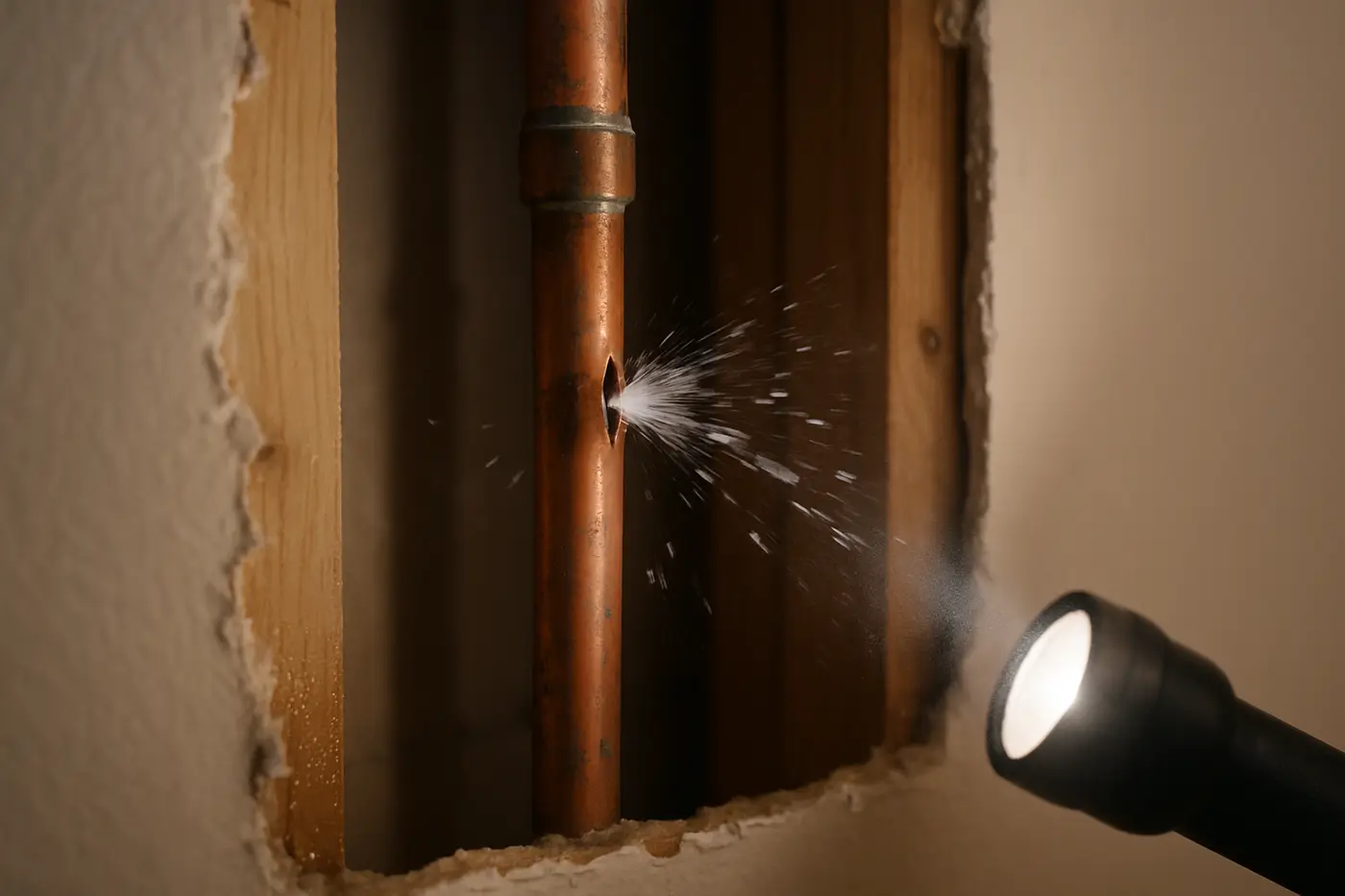
Split copper pipe spraying water inside an opened wall in a Phoenix home

Not sure it is urgent?

Send a photo with the form. We will tell you whether it can wait until morning or needs a plumber tonight.

When to call

Signs you needburst pipe repair.

Any of the following is worth a call the same day. Water on a slab home has nowhere to drain, so the wet area is nearly always bigger than the stain you can see.

  • Water is spraying or running from a pipe, fitting or hose and the fixture valve does not stop it
  • A ceiling or wall is wet, bulging or dripping with no fixture above it running
  • The meter is spinning fast with everything in the house turned off
  • A hose bib, backflow preventer or garage pipe split during a winter freeze
  • A washing machine hose or toilet supply line burst and pressure in the house feels high
  • You have gray plastic supply pipe and a fitting has failed
  • Water is heading for the electrical panel, outlets or the air handler closet

Our process

How burst pipe repairruns, step by step.

From the first call to the last pressure test, you will know what is happening, why, and what it costs at each stage.

  1. Step 1: Shut the main and call

    You close the customer-side main valve at the front of the house and open a hose bib to drain pressure. On the phone you get the dispatch fee and an honest arrival window, or a straight answer that this repair can wait for daytime rates.

  2. Step 2: Find the break

    The plumber follows the wet path back to the source. Water travels along framing, so the stain is often not where the break is. When the source is hidden, acoustic and thermal detection narrows it before anything is opened.

  3. Step 3: Repair the section

    Pipe is cut back to sound material and replaced with copper or PEX on approved fittings. Polybutylene is transitioned to PEX. The PRV and expansion tank are checked so the repair does not fail the same way again.

  4. Step 4: Test and document

    Water back on slowly, air bled at the fixtures, every joint checked dry, PRV set. You get the failed part, photos and a written report describing the cause for your insurer.

Price guide · USD, 2026

What burst pipe repaircosts in Phoenix.

Typical Phoenix ranges. The final price is quoted on site, in writing, before any work starts. After-hours dispatch is explained on the phone.

ItemTypical range
After-hours, weekend or holiday emergency dispatch Explained on the phone before dispatch$150–$350
Burst or leaking pipe repair (accessible) Copper, PEX or galvanized section$250–$1,200
Burst pipe with drywall access Access and patch, not paint$600–$2,500
Pressure reducing valve replacement Often the root cause; done in the same visit$350–$900
Electronic leak detection When the source is hidden$250–$600
Whole-house repipe (PEX) 1,500–3,000 sq ft, permit and drywall access$6,000–$18,000

Ranges cover labor, standard parts and permits where noted, for 2026. The number you approve on the written quote is the number you pay; if the scope changes once walls or slab are opened, we stop and re-quote in writing.

Full price guide

In depth

Burst Pipe Repair in Phoenix: how the job actually runs.

A burst pipe is any supply line, fitting or hose that has let go and is putting pressurized water where it does not belong. In Phoenix that usually means a polybutylene fitting in a 1980s tract house, a pinhole in copper, a washing machine hose blown by a failed pressure reducing valve, or a hose bib split by a rare winter freeze. Pressurized water does not stop on its own, so a burst pipe is an emergency until the main valve is closed. After that, the repair is often a same-visit job, and sometimes a next-morning one.

Shut the water off first

Before you read further: close the customer-side main shut-off. In most Phoenix homes it is at the front of the house where the service line comes up out of the ground, near a hose bib and often next to the PRV. Turn it clockwise until it stops. If it is stuck, the meter box near the sidewalk has a city-owned valve you can use in an emergency with a meter key or pliers, carefully. Then open the lowest hose bib to drain pressure out of the house. Step-by-step instructions are in what to do when a pipe bursts.

If the water is running near the electrical panel, outlets or the air handler, stay out of that area. Do not stand in water and touch a breaker.

Where Phoenix pipes burst, by housing era

The material in your walls predicts where it fails.

Before 1960: galvanized steel. Historic districts such as Willo and Coronado, and older Sunnyslope, Maryvale and Alhambra tracts. Galvanized rusts from the inside out. You see low pressure and rusty water for years, then a thread rusts through at a fitting or a section splits. Repairing one spot often disturbs the next weak one, so galvanized repairs sometimes turn into a conversation about repiping.

1960s to 1990s: copper. Often run under the slab. Pinholes from very hard water (10 to 17 grains per gallon), abrasion where the pipe passes through the slab, and electrolysis. Above-slab copper bursts are quick repairs; a leak under the slab is a different job, covered on our slab leak repair page.

Roughly 1978 to 1995: polybutylene. Gray plastic supply pipe in many Phoenix-area homes of that era, including tracts in Paradise Valley Village, Ahwatukee and Deer Valley, and multi-unit communities around Biltmore. Chlorine in the water degrades it, and it fails at fittings and along runs, usually without warning. The class-action settlement (Cox v. Shell, 1995) closed long ago, so the cost is the owner’s. One PB failure is a repair; the second one is a sign. Read polybutylene pipes in Phoenix homes.

After the mid-1990s: PEX and CPVC. Fewer material failures, but the pipe is not the only thing that bursts. Failed PRVs, water heater fittings, angle stops and braided supply hoses cause most of the floods in Desert Ridge, Laveen and Estrella houses. PEX exposed to sun on the exterior degrades and splits.

Why Phoenix pipes burst: pressure, heat and the odd freeze

Many Phoenix zones deliver street pressure above 80 psi. The pressure reducing valve near your main shut-off knocks that down, but PRVs wear out after roughly 10 to 15 years. When one fails open, full street pressure hits every washing machine hose, toilet supply line and water heater fitting in the house, and the weakest one goes. A PRV failure often shows up first as a banging pipe or a relief valve dripping at the water heater; treat those as a warning.

Summer heat above 110°F cooks pipe in garages, attics and outdoor walls, and thermal expansion in a closed system with a dead expansion tank stresses every joint. Hard freezes are rare but real: a few nights near or below freezing most winters, mainly December to February, split exposed hose bibs, backflow preventers, irrigation lines and pipes in unheated garages and attics. Watch for freeze warnings ahead of those nights. The early February 2011 cold snap did it across the Valley in one week.

How the repair runs

Find the failure. With the water off, the plumber traces the wet path back to the source. A burst behind drywall shows as a wet baseboard or a stain; a burst in the attic shows as a ceiling stain, sometimes far from the break because water travels along framing. If the source is not obvious, electronic leak detection with acoustic and thermal equipment narrows it before anything is opened.

Open only what is needed. Drywall is cut in a clean rectangle sized for the repair and patched after; paint is yours or your handyman’s.

Replace the section. Copper is cut back to sound pipe and replaced with copper or a PEX section on approved fittings. Polybutylene is cut out to the nearest fittings and transitioned to PEX. Galvanized is cut back to a good thread and transitioned. The plumber checks the PRV and the expansion tank at the same time, because a repair that leaves a failed PRV in place will be back.

Pressure up and test. Water on slowly, air bled at fixtures, every joint checked dry, PRV set and verified with a gauge on a hose bib.

What it costs

Typical Phoenix ranges, final price quoted on site in writing before work starts:

  • After-hours, weekend or holiday dispatch: $150 to $350, explained on the phone before dispatch.
  • Burst or leaking pipe repair, accessible: $250 to $1,200 for a copper, PEX or galvanized section.
  • Burst pipe with drywall access: $600 to $2,500, including the access cut and patch but not paint.
  • Pressure reducing valve replacement: $350 to $900, often done in the same visit when a failed PRV caused the burst.
  • Electronic leak detection: $250 to $600 when the source is hidden.
  • Whole-house repipe to PEX: $6,000 to $18,000 for a 1,500 to 3,000 square foot home, with permit and drywall access.

A burst you can reach at 2 a.m. costs the dispatch fee plus the low end. A burst that can wait until morning, because the main is closed and nobody needs water overnight, saves you the dispatch fee entirely. We say so when that is the case.

Repair or repipe?

Your situationRepair the sectionTalk about a repipe
First failure in PEX, CPVC or above-slab copperYes
Failed supply hose, angle stop or PRVYes, and replace the PRV
Second polybutylene failure in the houseYes
Galvanized with low pressure and rusty waterPossible, but expect the next oneYes, plan for it
Copper with repeated pinholesYes, or reroute the worst line
Remodel already planned with walls openYes, the cheapest time to do it

Insurance and permits

Standard Arizona homeowners policies (HO-3) cover sudden and accidental water discharge and the damage it causes to floors, drywall and contents. They usually exclude the cost of repairing the pipe itself, and they exclude gradual leaks. Photograph the wet area before anything is moved, keep the failed fitting or hose, and ask for the plumber’s written report. A spot repair does not need a permit. A whole-house repipe does, from the City of Phoenix Planning and Development Department or the equivalent in Scottsdale, Tempe, Mesa, Paradise Valley or Tolleson, and the permit is part of the repipe price.

If the main is closed and the house is dry, you have already done the hard part. Call or send the form, tell us what you saw, and you will get a dispatch fee and an honest arrival window, or a straight answer that this one can wait for morning.

Last updated August 28, 2026
Ask questions

Burst Pipe Repair, explained.

Straight answers about response times, after-hours pricing, permits and what to expect from burst pipe repair in Phoenix.

All questions
I shut off the main. Is it still an emergency tonight?

Often not, and that saves you the dispatch fee. If the water is off, nothing is still spreading, and your household can go without water until morning, the repair can be a daytime call at the $89 to $189 service rate. It stays an emergency if you cannot get the main fully closed, if water reached the electrical panel or outlets, if someone in the home cannot go without water, or if a ceiling is sagging and holding water. Tell us the situation on the phone and you will get a straight answer either way.

Why did a nearly new washing machine hose burst?

Usually because the pressure reducing valve at the front of the house has failed. Many Phoenix zones deliver street pressure above 80 psi, and the PRV is what keeps house pressure reasonable. PRVs wear out after roughly 10 to 15 years, and when one fails open, every supply hose, toilet fill line and water heater fitting sees full street pressure. The hose was simply the weakest point. Replacing it without replacing the PRV means the next weakest point goes. PRV replacement runs $350 to $900 and is often done in the same visit.

My house has gray plastic pipe. What does that mean for a burst?

Gray plastic supply pipe is almost certainly polybutylene, installed in many Phoenix-area homes built roughly 1978 to 1995. Chlorine in the water degrades it, and it fails at fittings and along runs with little warning. A single failure is repaired by cutting the polybutylene back to sound pipe and transitioning to PEX. A second failure anywhere in the house is a signal that the rest is not far behind, and a whole-house repipe to PEX, typically $6,000 to $18,000 with permit, is the durable fix. The Cox v. Shell settlement closed in the 1990s, so there is no claim left to file.

Will you have to open my walls?

Only where the pipe is, and only as much as the repair needs. A burst at a visible hose bib, angle stop, water heater fitting or exposed garage line needs no drywall work at all. A burst inside a wall or ceiling needs a rectangular access cut sized to the repair, which is patched afterward; painting is not included. When the source is not obvious, electronic leak detection with acoustic and thermal tools, $250 to $600, is cheaper than exploratory holes. Water travels along framing, so the stain is often several feet from the break.

Does homeowners insurance cover a burst pipe in Arizona?

A standard HO-3 policy covers sudden and accidental water discharge, which is what a burst pipe, failed supply hose or ruptured water heater is, and it covers the resulting damage to flooring, drywall and contents. It usually does not cover the plumbing repair itself, and it excludes gradual leaks that went unaddressed. Photograph everything before cleanup, keep the failed part, and get the plumber's written report describing the cause; adjusters rely on all three. Monsoon runoff from outside is not a burst pipe and needs a separate NFIP flood policy.

Do pipes actually freeze in Phoenix?

Rarely, but yes. Overnight lows near or below freezing happen a few nights most winters, mainly December to February, and exposed hose bibs, backflow preventers on irrigation systems, irrigation lines and pipes in unheated garages and attics split when they do. The early February 2011 cold snap caused burst pipes and cracked backflow devices across the Valley in a single week. Before a forecast freeze, wrap exposed hose bibs and backflow assemblies and know where your main shut-off is. A split hose bib is a quick repair; a split backflow assembly is more involved.

How long is the water off during a repair?

For an accessible burst, the water is typically back on within the same visit. The plumber cuts back to sound pipe, fits the new section, pressures the house up slowly and checks every joint before leaving. Repairs behind drywall take longer for the access work but usually finish the same day. If the job needs a special-order part or turns into a repipe, the plumber caps the failed line so the rest of the house has water while the larger job is scheduled and permitted. You will not be left without water overnight without being told why.

Related services

Helpful reading

Guides that go withthis service.

Practical, Phoenix-specific reading on shut-offs, costs, slab leaks, polybutylene and monsoon season.

Emergency Plumbing

Burst Pipe Repair across Phoenix, any hour. Tell us what is happening and get the price and an honest arrival window before anyone is dispatched.

(602) 854-9980
Plumber's van driving through a Phoenix neighborhood with Camelback Mountain in the background