In depth
24 Hour Emergency Plumber in Phoenix: how the job actually runs.
An emergency plumber is the one you call when water is running and you cannot make it stop, when sewage is coming up instead of going down, or when the house has no water and waiting until morning is not realistic. This page covers how 24-hour service works in Phoenix, what actually qualifies as an emergency, and what it costs to have a licensed plumber come out at night, on a weekend or on a holiday instead of during business hours.
What counts as a plumbing emergency
Call now, whatever the hour, if:
- Water is flowing from a pipe, fitting, water heater or supply hose and the fixture valve will not stop it.
- Sewage is backing up into a tub, shower or floor drain, or more than one toilet is gurgling at once.
- You smell natural gas. Leave the building first, call the gas utility’s emergency line, then call a licensed plumber for the house side.
- The main shut-off is closed and the whole house is without water because of a leak you cannot find.
- A water heater is leaking from the tank body, not a fitting, and the water is spreading across a garage or closet floor.
- Water is running toward an electrical panel, outlets or the air handler.
Problems that can usually wait until the next business day, at the lower service call rate: a single slow drain when other fixtures work, a toilet that runs but does not overflow, a drip at a faucet or hose bib, a water heater that makes noise but still heats, and a pilot light that went out once and relit. We tell you this on the phone. Paying an after-hours dispatch fee to fix a dripping faucet is a waste of your money.
What happens when you call
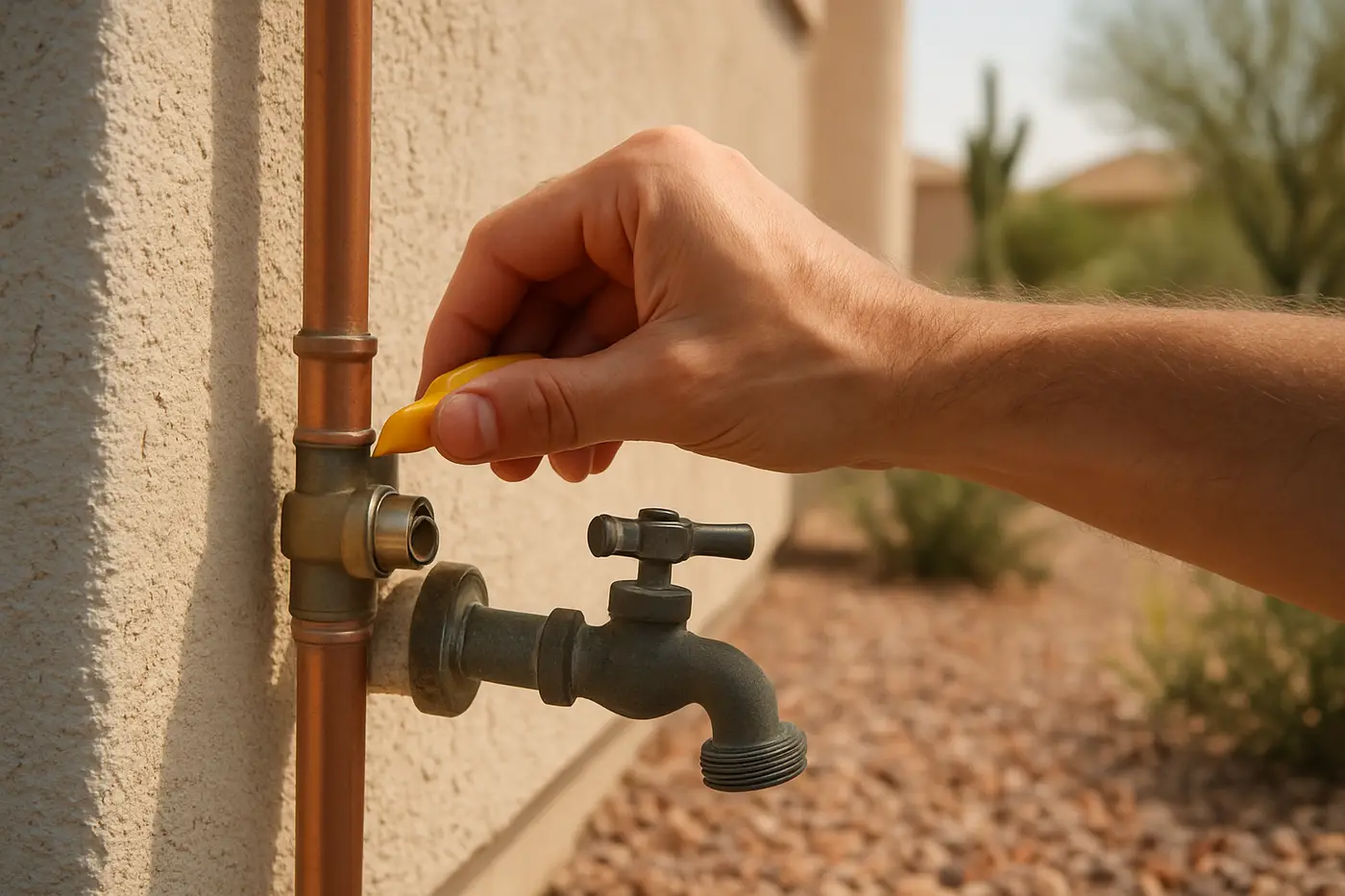
Whoever answers asks a short set of questions: what is leaking or backed up, whether the water is still running, whether you have found the shut-off, and where in the Valley you are. If the water is still running, you get walked to the customer-side main shut-off, which in most Phoenix homes is at the front of the house near a hose bib where the service line comes out of the ground, often next to the pressure reducing valve. The full walk-through is in how to shut off the water to your Phoenix home.
Then you get two numbers before anyone rolls: the after-hours dispatch fee, and an honest arrival window based on where the nearest plumber actually is. A plumber finishing a sewer call in Ahwatukee is not going to be in Downtown Phoenix in fifteen minutes, and saying otherwise helps nobody. If the window does not work for you, you have lost nothing.
How the visit runs
On arrival the plumber confirms the water is off, finds the failure and shows it to you. You get a price in writing before any work starts. That price uses the typical Phoenix ranges further down this page as a guide, but the number on the paper is the number you pay.
Most night calls end in one of three ways. The failed part is replaced on the spot from truck stock: a supply hose, angle stop, fill valve, PRV, section of copper or PEX, or a water heater valve. Or the immediate problem is stopped and the house made safe, with the full repair scheduled for daytime rates because it needs a permit, a part, or several hours of drywall access. Or the problem turns out to be something that could have waited, in which case the plumber says so.
Homes, condos and apartments
A single-family home on a slab-on-grade foundation is the standard Phoenix emergency. The customer owns everything on the house side of the meter, so the main valve, the PRV, the water heater and every line under the slab are yours to fix. Most residential calls land on burst pipe repair, water heater repair and emergency drain cleaning.
Condos and apartments are different. In a Downtown Phoenix high-rise or a Tempe apartment block, water from one unit travels down through the units below, and the shut-off you need may be in a shared chase or a mechanical room. Call building management or the HOA emergency contact at the same time you call us; access and the master shut-off are usually theirs.
Rental properties: the tenant calls, the owner pays, and the plumber needs authorization from whoever holds the checkbook before work starts.
Phoenix causes, by season
Summer (June through September). Highs above 110°F cook garage water heaters and outdoor pipe. Water demand peaks, and pressure reducing valves that were already 10 to 15 years old fail, sending street pressure above 80 psi into washing machine hoses, toilet supply lines and water heater fittings. Thermal expansion pops relief valves on heaters without a working expansion tank.
Monsoon (officially June 15 to September 30). Short violent downpours surcharge sewer laterals and yard drains. Flat-roof homes with blocked scuppers pond water and leak inside. Sewage ejector and sump pumps in the few below-grade rooms around the Valley get overwhelmed. Storm water into the garage and a sewer lateral backing up look similar at 2 a.m.; the fix is very different.
Winter (December through February). A few nights near or below freezing most years split exposed hose bibs, backflow preventers, irrigation lines and pipes in unheated garages and attics. The early February 2011 cold snap did this across the Valley at once.
Any month. Polybutylene fittings in 1978 to 1995 homes, pinholes in under-slab copper in 1960s to 1990s homes, and galvanized steel finally rusting through in pre-1960 homes in Willo, Coronado and Sunnyslope.
What it costs, honestly
After-hours, weekend or holiday dispatch is $150 to $350, explained on the phone before dispatch. A business-hours service call and diagnostic is $89 to $189 and is credited toward the repair. The repair itself is on top, and it is quoted in writing on site. Typical Phoenix ranges: an accessible burst or leaking pipe section $250 to $1,200, main sewer line clearing $250 to $700, water heater repair $150 to $700, toilet repair $150 to $450.
The dispatch fee is the price of a plumber leaving their house at midnight, which is why we tell you when a problem can wait. Cheap after-hours ads often come from unlicensed operators working under Arizona’s handyman exemption for jobs under $1,000. Verify any plumber’s license at azroc.gov; the plumber we put you in touch with gives you theirs on request. More in our emergency plumber cost guide.
Emergency or morning?
| Situation | Call now | Can wait for daytime rates |
|---|---|---|
| Water running, valve will not stop it | Yes | |
| Sewage backing up into tub or shower | Yes | |
| Gas smell | Leave, call the gas utility, then a plumber | |
| Water heater leaking from the tank body | Yes, shut the water and power or gas first | |
| Single slow drain, other fixtures fine | Yes | |
| Toilet runs but does not overflow | Yes | |
| Dripping faucet or hose bib | Yes | |
| No hot water, no leak | Yes, unless someone in the home cannot go without | |
| Main shut-off closed, whole house dry | Yes |
Insurance and permits
Standard Arizona homeowners policies (HO-3) cover sudden and accidental water discharge and the resulting damage, but usually exclude the cost of repairing the pipe itself, gradual leaks, and slab leak access. Photograph everything before it is moved, keep the failed part, and ask the plumber for a written report; adjusters ask for all three. Water heater replacement, repipes, sewer line replacement and gas line work need a permit from the City of Phoenix Planning and Development Department or the equivalent department in Scottsdale, Tempe, Mesa, Paradise Valley or Tolleson. That is a daytime process, which is why a night call often ends with the problem stopped and made safe.
If water is running right now, shut the main valve first and then call or send the form. You will get the dispatch fee and a real arrival window before you commit to anything.
Last updated September 02, 2026