- #monsoon
- #flat-roof
- #sewer-backup
- #storm-drainage
- #phoenix
- #prevention
Monsoon season in Phoenix runs officially from June 15 to September 30, and the plumbing problems it causes are the same every year: roof scuppers and drains overflowing on flat-roof homes, yard drains and sewer laterals surcharging and backing up into tubs, storm water pouring into garages and below-grade rooms, sump and sewage ejector pumps overwhelmed, and backflow devices and irrigation lines torn up by debris. You prepare by clearing scuppers and yard drains in early June, camera-inspecting an old sewer lateral, testing any pumps, checking the backflow assembly, and knowing where your shut-off valves are.
The rest of this article takes each failure in turn: who gets it, what it costs to fix, and what to do before the first haboob.
What monsoon actually does
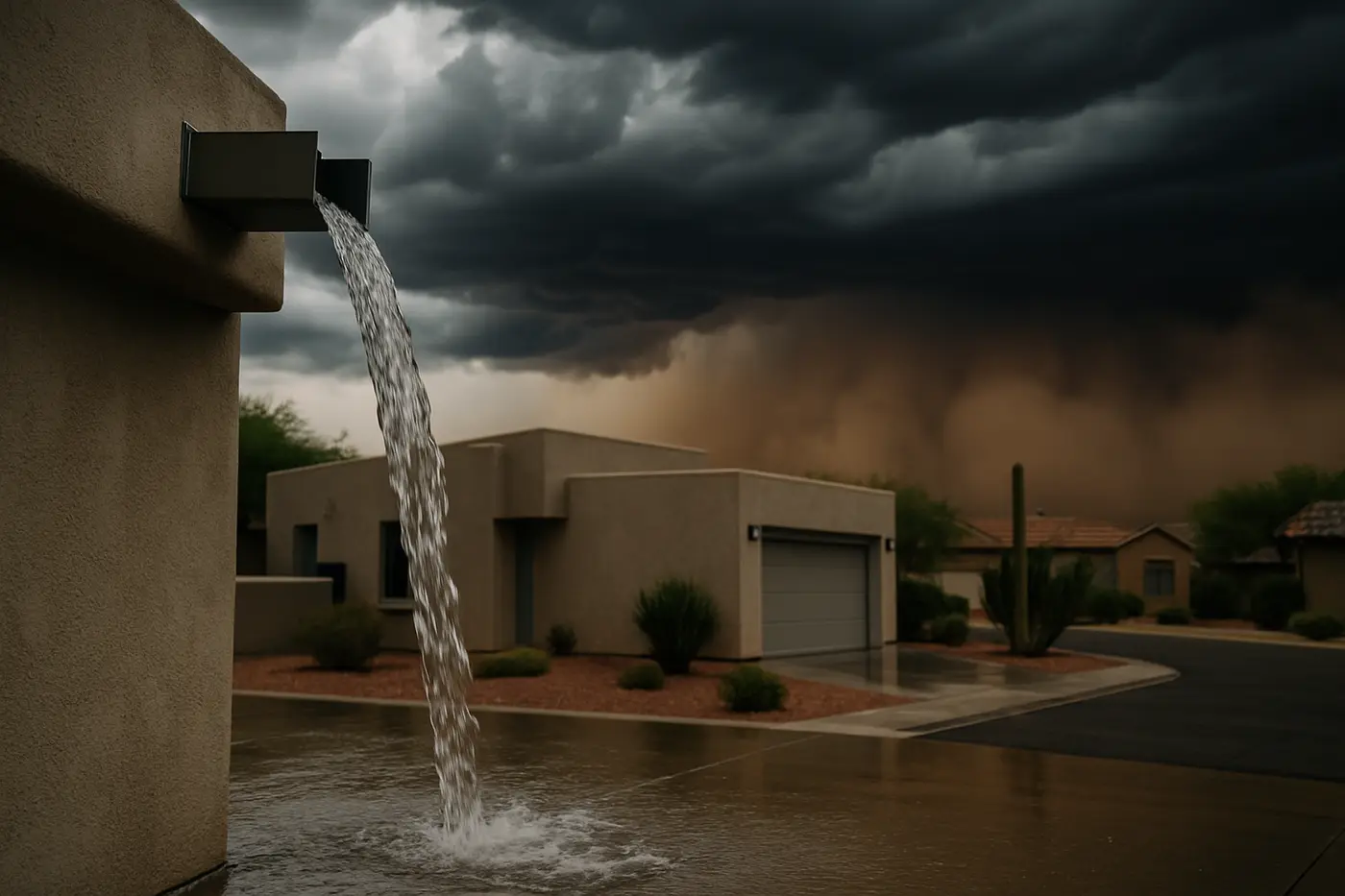
Phoenix does not get steady rain. It gets dust storms that load every roof and drain with grit, followed by short, violent downpours that drop a lot of water in a few minutes, followed by flash flooding as that water runs off hard ground and pavement. Flash flood and dust storm warnings for the Valley come from the National Weather Service. The volume is the problem. A drain that handles a winter shower is not the same drain during a cell that dumps an inch in half an hour.
The plumbing that fails in a monsoon storm was almost always marginal already: a scupper half blocked by palm fronds, a clay lateral with a root ball in it, a pump that has not cycled since last September.
The six monsoon plumbing problems
| Problem | Who gets it | What it looks like | Before the season |
|---|---|---|---|
| Roof scuppers and drains overflow | Flat and low-pitch roofs in mid-century tracts, Santa Fe and territorial homes | Ceiling stains, water down interior walls, ponding on the roof | Clear scuppers, check downspouts, walk the roof after every haboob |
| Yard drains and sewer laterals surcharge | Homes with clay or Orangeburg laterals, mature trees, sunken yards | Sewage in tubs and showers, gurgling toilets, yard drains standing full | Camera inspection, clear roots, grade yard drains away from the house |
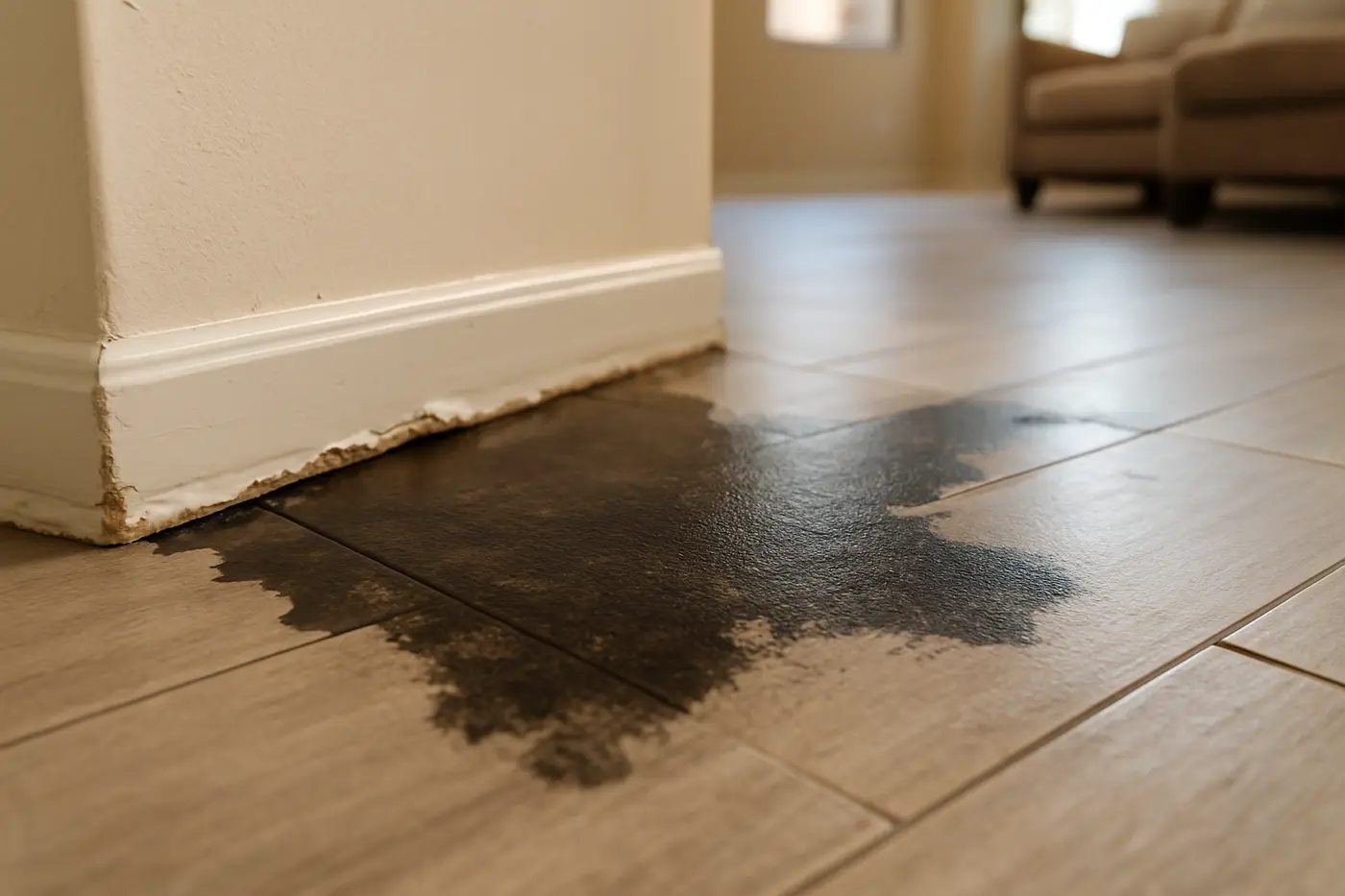
| Storm water in garages and below-grade rooms | Homes below street grade, sunken living rooms, converted garages | Water under the garage door, soaked drywall low on walls | Sandbags or door dams, clear the driveway drain, check thresholds |
| Sump and ejector pumps overwhelmed | Homes with basements or below-grade fixtures, some commercial | Pump runs continuously, alarm sounds, pit overflows | Test the pump, clean the pit, confirm the check valve and discharge |
| Backflow devices damaged | Irrigation systems, commercial properties | Device leaks, irrigation runs constantly, failed annual test | Inspect the assembly, schedule the annual certified test |
| Irrigation lines broken by debris and flow | Large lots, flood irrigation areas, long runs | Wet spots, geysers when the timer runs, high water bill | Walk the lines, cap exposed heads, add a master valve |
Flat roofs and scuppers
Flat and low-pitch roofs are everywhere in Phoenix: the 1950s to 1970s tract homes in Maryvale, the mid-century blocks of Midtown and Uptown, and the Santa Fe and territorial-style homes across the Valley. Water leaves those roofs through scuppers, the rectangular openings in the parapet, and sometimes through interior roof drains.
Dust storms fill scuppers with grit and palms drop fronds onto them. A blocked scupper means the roof ponds, and standing water finds every weak seam in the membrane, which is why the ceiling stain appears during a storm and not before.
Clear every scupper in early June, and again after each haboob. Check that the downspout or splash block below each one carries water away from the wall rather than into a planter against the foundation.
Sewer laterals and yard drains
Heavy runoff loads yard drains and, in some areas, the sewer system itself. If your lateral, the pipe from the house to the city main, is a mid-century clay or Orangeburg line, it has probably been invaded by roots from ficus, mesquite, palo verde, mulberry or palms. Under normal flow it drains, slowly. Under storm load sewage rises to the lowest fixture in the house.
The property owner owns the lateral all the way to the main. The historic districts of Willo and Coronado, older Sunnyslope, Maryvale and Arcadia all have laterals of that age, and Arcadia and Laveen add flood irrigation that keeps soil wet and roots aggressive.
Before the season, a sewer camera inspection at $200 to $500 shows you what you have. Main line clearing through the cleanout runs $250 to $700; hydro jetting for roots and scale runs $400 to $900. A spot repair on a collapsed section is $1,500 to $5,000, and full replacement runs $5,000 to $20,000 or more depending on length, depth and whether trenchless is possible. Our sewer line repair page lays out the choices, and emergency drain cleaning covers what happens when it backs up during the storm itself.
Garages, sunken rooms and pumps
Most Phoenix homes have no basement, but plenty have a garage below street grade, a sunken living room, or a converted garage with a threshold an inch above the driveway. Flash-flood runoff follows the driveway straight in.
Keep the driveway trench drain clear if there is one, and confirm yard drains carry water to the street, not toward the slab. If the home has a sump or sewage ejector pump, lift the float in early June to run it, clean the pit, and check that the check valve holds and the discharge line is clear. A pump idle since last monsoon is the one that fails on the first big night.
Water that enters from outside at grade is flood, not a plumbing failure, and a standard Arizona HO-3 policy does not cover it. That needs a separate flood policy through the NFIP, which is worth knowing in June rather than in August.
Backflow devices and irrigation
Irrigation backflow assemblies sit low at the front of the property, where wind-driven debris and flowing water jam the check valves with grit. Assemblies on irrigation systems and commercial properties in Phoenix and most Valley cities require annual testing by a certified tester, and a device that passed in spring can fail after a July storm. Testing is $100 to $250 and repairs run $300 to $1,200.
Irrigation lines break too. Exposed PVC that has spent the summer in sun above 110°F is brittle, and moving debris snaps risers and heads. After each storm, run each zone and look for geysers, wet spots and buried heads.
What monsoon does not cause, but reveals
Two things get blamed on the weather that are not rain. A sewer smell in July is usually a dry P-trap in an unused shower or floor drain, since water evaporates fast in the heat; pour a bucket of water down it. And a wall leak that appears during a storm is sometimes a supply line that was already failing. If the meter moves with everything off, it is not the rain; our slab leak signs post explains how to check.
Pre-monsoon checklist, by early June
- Clear every roof scupper and drain, and check the splash blocks below them.
- Camera-inspect the sewer lateral if the home predates the 1970s or has ever backed up.
- Clear and grade yard drains toward the street.
- Test any sump or ejector pump, clean the pit and check the discharge.
- Inspect the irrigation backflow assembly and book the annual test.
- Walk the irrigation lines and cap anything exposed or broken.
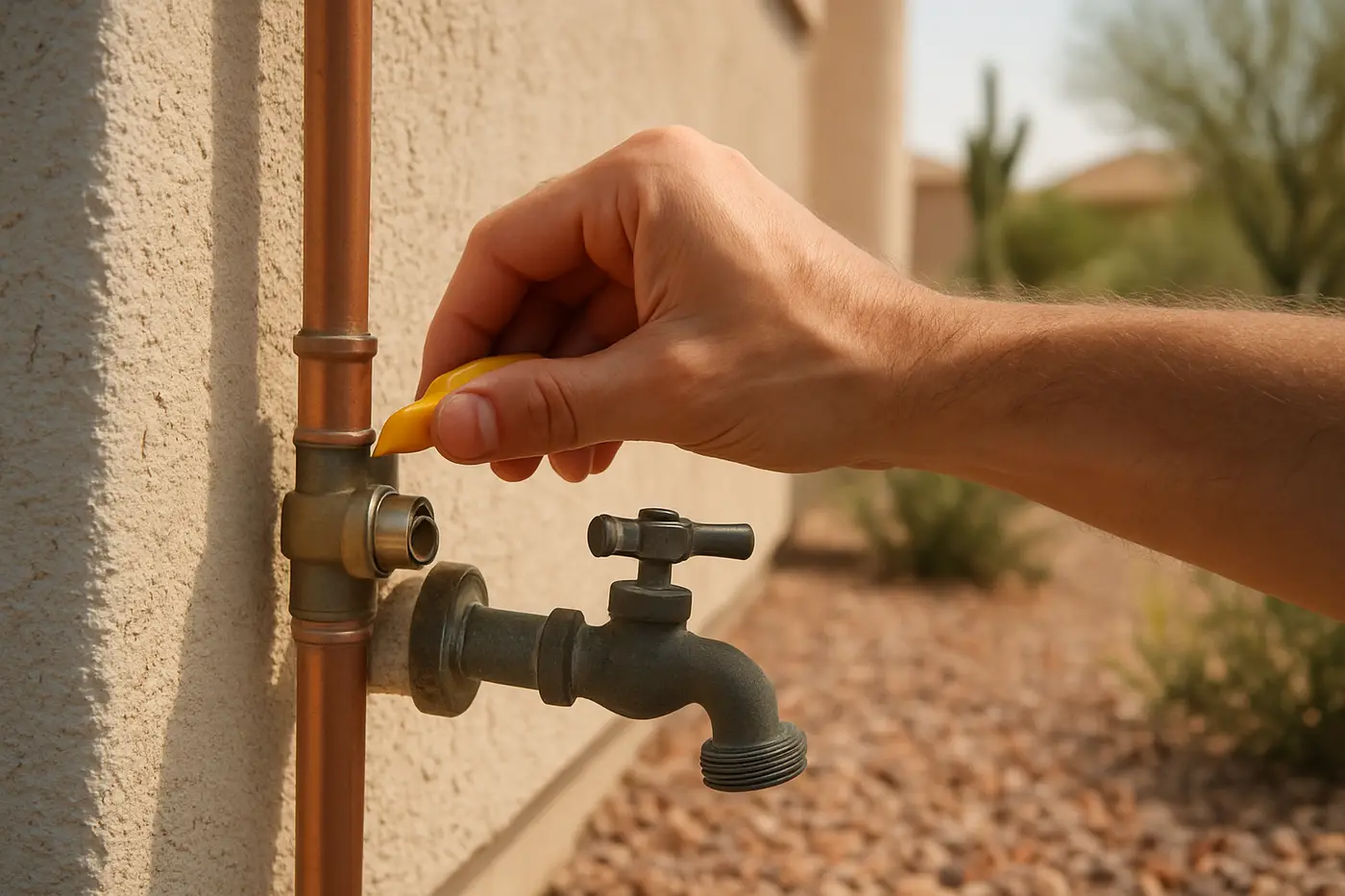
- Find and test the house main shut-off, the water heater inlet and the angle stops. Our shut-off guide shows where each one is.
- Read the water and flood sections of your insurance policy.
During a storm
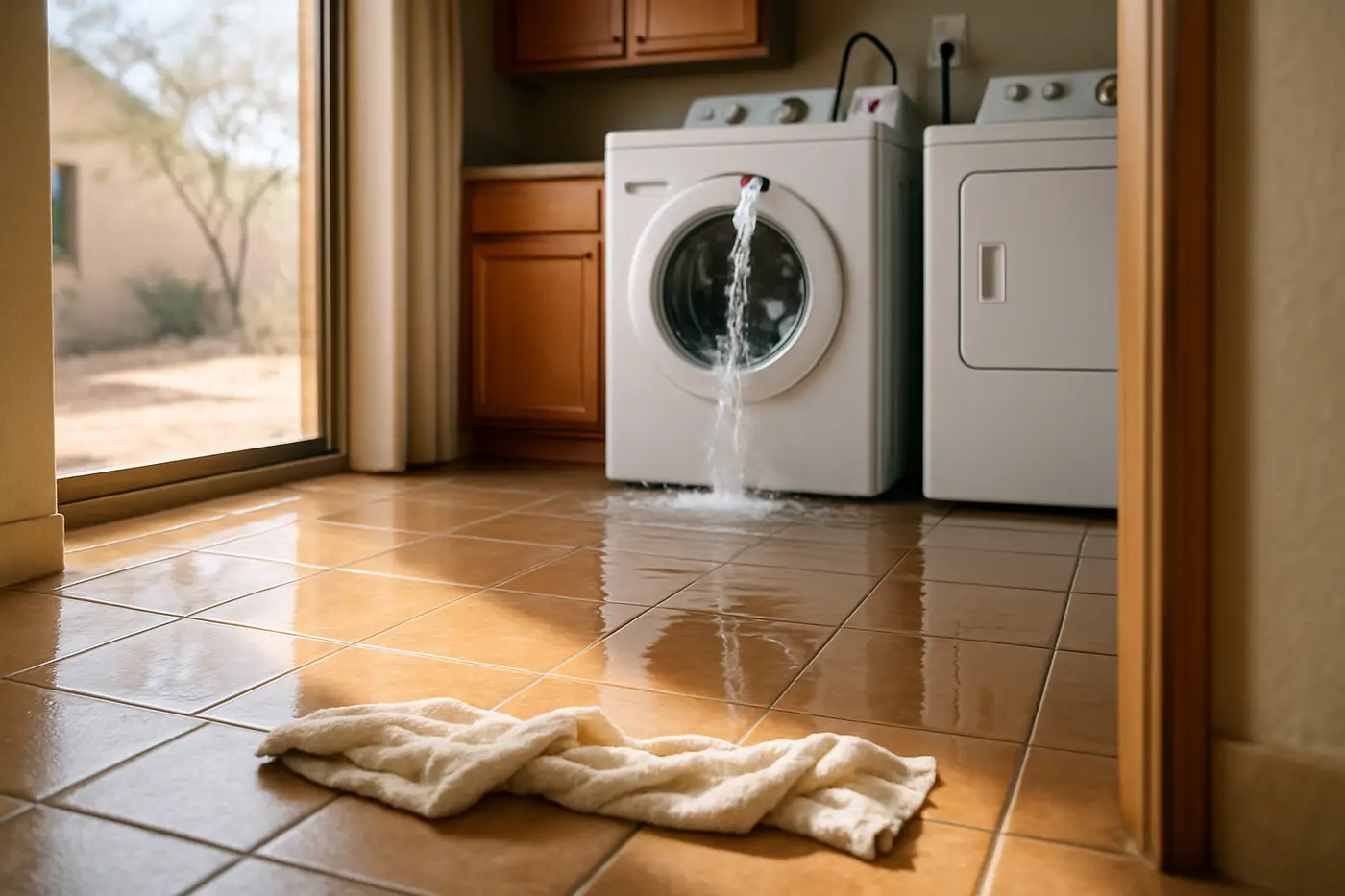
- If sewage rises in a tub or shower, stop using all water and call.
- If water comes through a ceiling, move belongings, photograph the stain, and let a plumber tell you afterward whether it was roof or pipe.
- If water is entering the garage, cut power to that room at the panel if the panel is dry and you can reach it without standing in water.
- Never go into standing water outdoors during a flash flood to reach a valve or a drain.
Key takeaways
- Monsoon runs June 15 to September 30 and brings volume, not steady rain; marginal drains and laterals fail first.
- Flat-roof homes fail at the scuppers. Clear them in June and after every dust storm.
- The homeowner owns the sewer lateral. Clay and Orangeburg lines with roots surcharge under storm load; camera them before the season.
- Storm water from outside is flood, covered only by a separate NFIP policy. Roof and pipe water fall under the homeowners policy.
- Test pumps, backflow devices and shut-off valves in early June while it is still a scheduled daytime job.