- #water-shutoff
- #main-valve
- #meter-box
- #emergency-response
- #phoenix
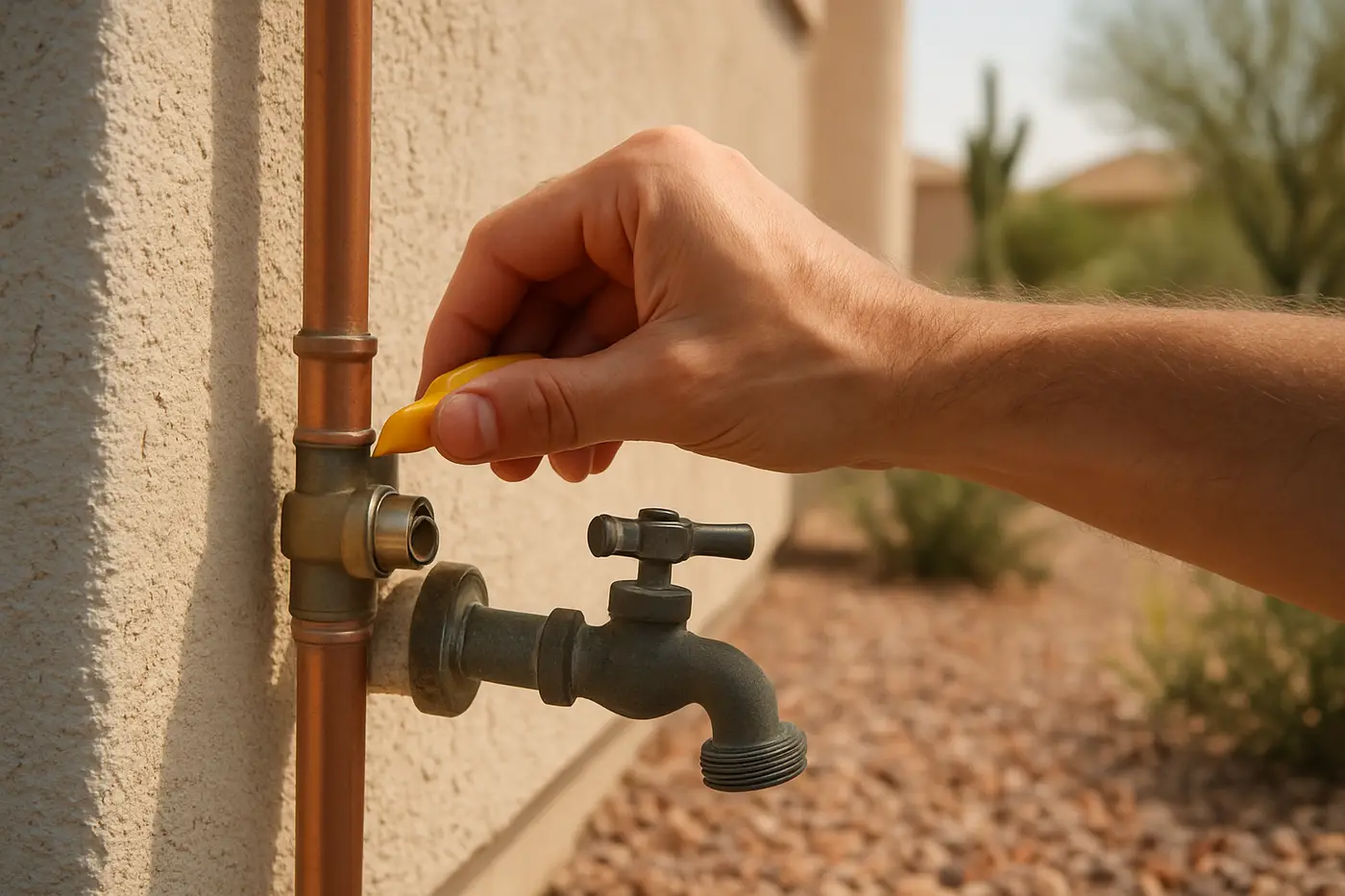
To shut off the water to a Phoenix home, go to the front of the house where the water service line comes up out of the ground, usually near the front hose bib and often next to the bell-shaped pressure reducing valve. Turn a lever-style valve a quarter turn so the handle sits across the pipe, or turn a round handle clockwise until it stops. If that valve is missing or seized, the meter box near the sidewalk holds a city-owned valve you can close with a meter key or pliers as a last resort, and then you call a plumber.
The rest of this article shows each valve in the order you should use them and how to make sure they work before the night you need it.
Why Phoenix houses are different
Phoenix homes are overwhelmingly slab-on-grade with no basement, so the service line rises out of the dirt outside the house and the main valve sits outdoors, in the sun, where it corrodes faster and gets hidden behind landscaping.
Two other local details matter. First, many Phoenix zones deliver street pressure above 80 psi, so most homes have a pressure reducing valve on the same riser as the main valve. Second, the City of Phoenix Water Services Department owns the meter and the main in the street; everything from the house side of the meter onward belongs to you, including the main valve, the PRV and every pipe in the home. In Scottsdale, Tempe, Mesa, Glendale, Chandler and Peoria the city utility plays the same role, and EPCOR does in most of Paradise Valley.
Your shut-off options, in the order to use them
| Valve | Where it is | When to use it | What it stops |
|---|---|---|---|
| Angle stop | Under sinks, behind toilets, at the washing machine box | A leak at one fixture or its supply line | Water to that fixture only |
| Water heater cold inlet | On top of the heater, on the cold pipe | A leaking heater or a burst hot line | Water into the tank and the hot side |
| House main valve | Front of the house, near the hose bib and PRV | A leak you cannot isolate at a fixture, or any leak inside a wall or slab | All water to the house |
| Meter valve | In the meter box near the sidewalk or curb | Only if the house valve fails and you can do it safely | All water to the property |
Close the smallest valve that stops the water; it keeps the rest of the house working.
Step 1: Angle stops at the fixture
Every toilet, sink and washing machine has a small valve where the supply line comes out of the wall. Toilets have one on the cold side; sinks have two, hot and cold. Turn the oval or football-shaped handle clockwise until it stops. Quarter-turn versions rotate ninety degrees.
If an angle stop leaks at the stem or spins without closing, move on to the main. Replacing failed angle stops is routine, inexpensive work.
In PEX and CPVC homes built after the mid-1990s the pipe is usually fine; it is the toilet or washing machine supply hose that lets go, often because the PRV wore out. Our leak detection page covers tracing a leak whose source is not obvious.
Step 2: The water heater
If the water is hot, or if the puddle is around the heater, the heater is part of the shut-off.
- Close the cold inlet valve on top of the tank. It is usually a lever or a round handle on the cold pipe feeding the heater.
- On a gas heater, turn the gas control knob to off. If the tank itself is leaking, also close the gas shut-off valve on the supply pipe, which is a lever you turn so it sits across the pipe.
- On an electric heater, switch off its breaker at the panel.
Never try to relight a gas heater or touch the gas connections yourself; if you smell gas, leave the building, call the gas utility’s emergency line, then a licensed plumber. Our water heater repair page explains what happens next.
Step 3: The house-side main valve
Walk to the front of the house and find the hose bib. Within a few feet of it, look for a pipe coming straight up out of the ground and turning into the wall. On that riser you will usually see:
- A lever-style ball valve, or a round-wheel gate valve. That is your main.
- A bell-shaped brass fitting with a screw on top. That is the PRV.
- Sometimes a second valve above or below the PRV, and sometimes a hose bib tapped off the riser.
To close a ball valve, turn the lever a quarter turn so it sits across the pipe rather than along it. To close a gate valve, turn the wheel clockwise until it stops, without forcing it. Then open a faucet inside and confirm the flow stops within a few seconds.
If the wheel will not turn with normal hand pressure, stop. A snapped stem turns a manageable leak into an uncontrolled one. Go to Step 4.
Step 4: The meter valve, and when to use it
The meter box is a rectangular lid in the front yard near the sidewalk or curb. Inside is the meter and, on the street side of it, a valve. This valve is city property, and the rule is simple: use it only if the house valve fails and you can do so safely.
Lift the lid carefully; in summer it can be hot and the box can hold insects. Close the valve with a meter key or pliers, a quarter turn so the slot sits across the pipe. If it will not move, do not force it; call a plumber.
Once the meter valve is closed, call a licensed plumber the same day. You can check any contractor’s license status with the Arizona Registrar of Contractors. You need the house valve replaced so you never depend on the meter again, and you need the leak fixed.
After the water is off
- Open the lowest faucet and a hose bib to drain pressure out of the lines.
- If water reached outlets or the panel, and the panel itself is dry, switch off breakers to the wet rooms.
- Move rugs, boxes and furniture off the wet floor.
- Photograph everything before cleanup, including the failed part once the plumber removes it. A written plumber’s report, photos and the part are what an insurance adjuster will ask for.
- Call a plumber. If the leak is inside a wall or under the slab, describe what you saw so the right gear comes on the truck. Our burst pipe repair page covers how that call goes, and what to do when a pipe bursts walks through the first hour.
Condos, apartments and shared walls
In Downtown Phoenix high-rises and Midtown mid-rises, the unit shut-off is often behind an access panel in a closet or laundry area, and the building controls the riser. Use your angle stops first, then call building management, because a leak on the twelfth floor reaches the eleventh within minutes. In Biltmore-area townhomes with shared walls, isolate at the fixture and notify the HOA.
Test it before you need it
Once a year, on a normal day, close the main valve and open a faucet. If flow stops and the valve reopens without dripping at the stem, you are set. If it seizes, leaks or spins freely, have it replaced while it is a scheduled daytime job rather than a midnight emergency. Do the same with the angle stops under each sink and behind each toilet. Older tract homes in Maryvale and Alhambra often still have their original valves, and a valve that has never been exercised is the one most likely to fail when it matters.
Label the main, tell everyone in the house where it is, and keep a meter key by the front door.
Key takeaways
- Phoenix homes have no basements; the main valve is outside at the front of the house, near the hose bib and PRV.
- Close the smallest valve that stops the water: angle stop, then heater inlet, then main, then meter.
- Never force a seized valve. A snapped stem is worse than the leak.
- The meter valve is city property. Use it only if the house valve fails and you can do it safely, then call a plumber.
- Test your main and angle stops once a year and replace the ones that fail while it is still a daytime job.