- #emergency-plumber-cost
- #pricing
- #phoenix
- #slab-leak
- #water-heater
- #after-hours
An emergency plumber in Phoenix typically costs $150 to $350 for after-hours, weekend or holiday dispatch, plus the repair itself. Common emergency repairs run $250 to $1,200 for an accessible burst pipe, $250 to $700 to clear a main sewer line, $150 to $700 for a water heater repair and $1,500 to $4,500 for a slab leak spot repair. During business hours the service call is $89 to $189 and is credited toward the work. These are typical Phoenix ranges for 2026; the final price is quoted on site, in writing, before any work starts.
The rest of this guide breaks the bill into its parts, explains what pushes a job toward the top or bottom of each range, and covers the question nobody likes to ask at 2 a.m.: whether this needs fixing tonight at all.
The three parts of an emergency plumbing bill
Every emergency invoice in Phoenix is built from the same three pieces, whether the plumber itemizes them or not.
- Dispatch or service call. Getting a licensed plumber and a stocked truck to your door. During business hours it is $89 to $189, normally credited toward the repair. After hours, weekends and holidays it is $150 to $350, and a straight company tells you that number before anyone drives.
- Diagnosis. Sometimes the problem is obvious. Sometimes finding a leak behind drywall or under a slab takes acoustic gear, thermal imaging or a pressure test; electronic leak detection runs $250 to $600 and is usually credited if the same company does the repair.
- The repair. Parts, labor, access and cleanup. This is the part that varies most, and it is the reason a written quote matters more than a phone estimate.
A single flat number quoted on the phone for a leak nobody has seen is a marketing number, not a price.
Typical Phoenix emergency plumbing prices in 2026
| Job | Typical Phoenix range | What is included |
|---|---|---|
| Service call / diagnostic (business hours) | $89–$189 | Credited toward the repair |
| After-hours, weekend or holiday dispatch | $150–$350 | Explained on the phone before dispatch |
| Burst or leaking pipe repair (accessible) | $250–$1,200 | Copper, PEX or galvanized section |
| Burst pipe with drywall access | $600–$2,500 | Access and patch, not paint |
| Electronic leak detection | $250–$600 | Acoustic, thermal, pressure testing |
| Slab leak spot repair | $1,500–$4,500 | Jackhammer access, repair, slab patch |
| Slab leak reroute (overhead) | $2,000–$6,000 | Per line, slab stays closed |
| Drain clearing (sink, tub, shower) | $150–$450 | Cable machine |
| Main sewer line clearing | $250–$700 | Through cleanout |
| Hydro jetting | $400–$900 | Grease, scale, roots |
| Sewer camera inspection | $200–$500 | Often credited toward repair |
| Toilet repair (fill valve, flapper, wax ring) | $150–$450 | Parts and labor |
| Water heater repair | $150–$700 | Element, thermostat, valve, thermocouple |
| Tank water heater replacement (40–50 gal) | $1,400–$3,500 | Permit, expansion tank, code upgrades |
| Pressure reducing valve replacement | $350–$900 | Valve and labor |
| Gas leak detection and repair | $300–$1,500 | Pressure test, permit |
The after-hours dispatch fee is added to the repair range, not included in it, and the plumber should be able to name both numbers before starting.
What pushes a job toward the top of the range
After-hours timing. The dispatch fee is the obvious cost, but late-night work also means the supply house is closed; if a part is not on the truck, the job may become a cap tonight and a return visit tomorrow, often the cheaper path anyway.
Access. The biggest variable. A leaking angle stop under a vanity takes minutes; the same leak inside a wall means cutting drywall, and inside a slab means jackhammering concrete. That is why an accessible pipe repair starts at $250 and a slab leak spot repair at $1,500.
Slab work. Most Phoenix homes sit on slab-on-grade foundations, and copper supply lines in 1960s to 1990s homes often run under the slab. Homes built from the 1990s on frequently have post-tension slabs, where a reroute overhead at $2,000 to $6,000 per line is often safer than cutting the floor. Our slab leak repair page explains the trade-off.
Permits. Water heater replacement, repipes, sewer line replacement and gas line work require a permit from the City of Phoenix Planning and Development Department, or the equivalent department in Scottsdale, Tempe, Mesa, Paradise Valley or Tolleson. Permit fees and the inspection are part of the real price, and a water heater quote that skips the permit and expansion tank is not comparable to one that includes them.
Parts and code upgrades. A new tank water heater in Phoenix usually needs an expansion tank because most homes are closed systems with a PRV, and older gas heaters may need venting or connector upgrades to pass inspection. A failed PRV, common once the valve passes 10 to 15 years, is often the root cause behind a burst washing machine hose or toilet supply line; replacing it at $350 to $900 stops the next failure.
Pipe material. Galvanized steel in pre-1960 homes in Willo, Coronado and older Sunnyslope tracts is brittle and threaded; a section repair can turn into a longer run when the next joint crumbles. Polybutylene in 1978 to 1995 homes has the same problem: fixing one fitting rarely ends the story.
What pulls a job toward the bottom
- Calling during business hours when the problem can wait. A drip under a sink with the angle stop closed is a daytime job at daytime rates.
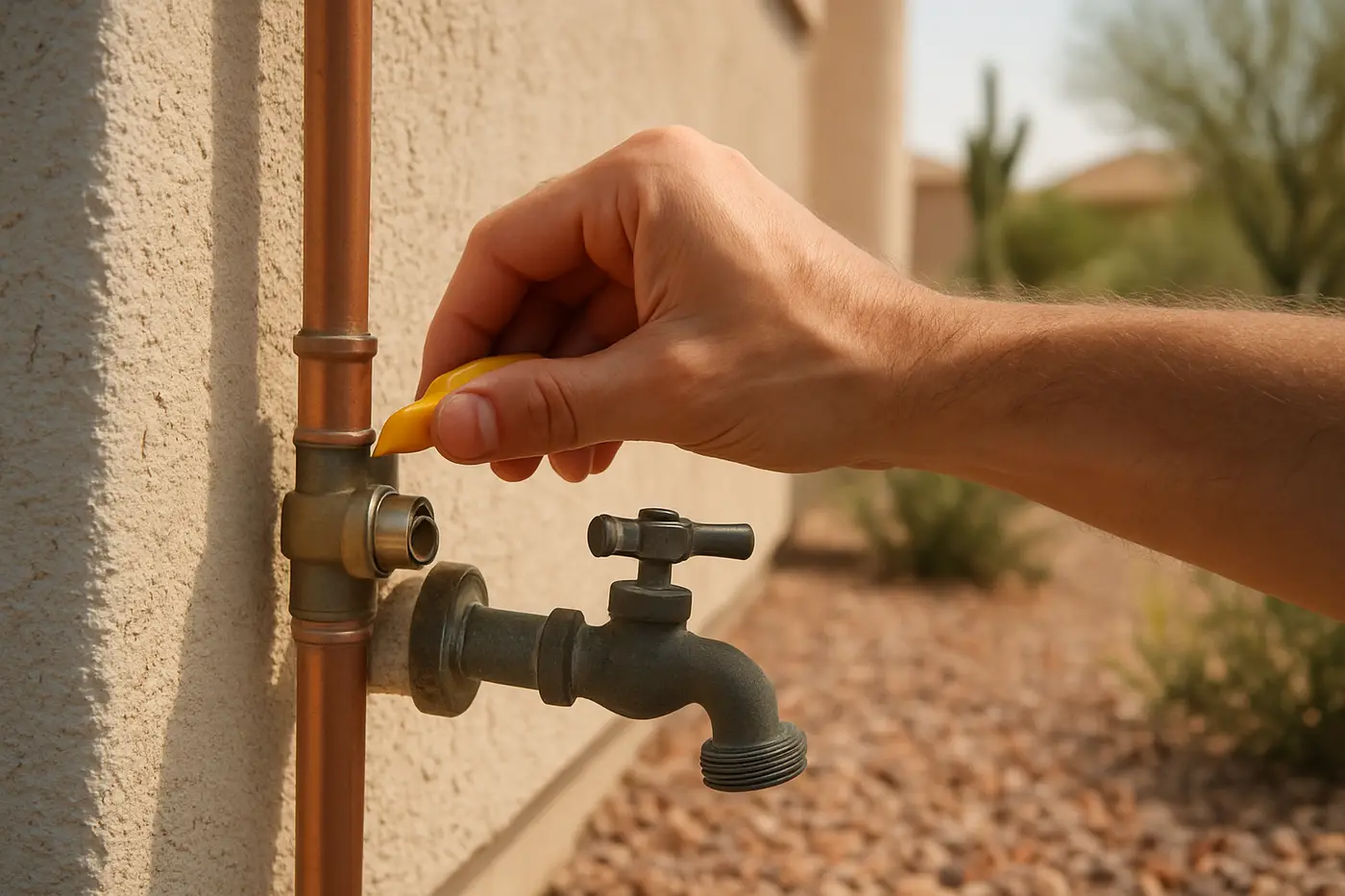
- Shutting off the water yourself before the plumber arrives. Less water damage, less cleanup, and the plumber starts on the repair instead of the flood. If you are not sure where your valve is, read how to shut off the water to your Phoenix home now, before you need it.
- Clear access. An empty cabinet, a cleared garage corner or a known cleanout location saves billable time.
- Knowing your house. Its age, whether it has been repiped, where the cleanout is and whether there is a PRV all shorten diagnosis.
Does it have to be tonight?
Honest answer: not always. These usually justify an after-hours call:
- Water you cannot stop at a valve, or a main valve that will not close.
- Sewage backing up into tubs or showers.
- A water heater leaking from the tank itself, not from a fitting you can isolate.
- Any gas smell. Leave the building, call the gas utility’s emergency line, then call a licensed plumber for the house side.
These can usually wait for morning once the water is off to that fixture:
- A dripping faucet or a running toilet.
- A slow drain that still drains.
- A water heater that is not heating but is not leaking.
- A small leak you have isolated with an angle stop and a bucket.
A plumber who tells you a problem can wait is giving you the most useful information of the night. Our 24 hour emergency plumber page explains how we sort calls, and burst pipe repair covers a same-night pipe repair.
How to compare quotes
Ask for three things before work starts: the dispatch fee, the repair price in writing, and what happens if the job changes once the wall or slab is open. A legitimate written quote names the company, describes the scope, lists the price or range, and says whether permit fees are included. The Arizona Registrar of Contractors (ROC) license number should be available on request; check it at azroc.gov before the truck arrives. Our post on cheap emergency plumbers in Phoenix covers what low advertised numbers leave out.
Insurance and the emergency bill
A standard Arizona HO-3 homeowners policy covers sudden and accidental water discharge: a burst pipe, a failed supply line, a ruptured water heater, and the damage that water causes. It usually does not cover the plumbing repair itself, excludes gradual leaks, and often excludes slab leak access unless the policy has a specific endorsement. Ask for a written report, keep the failed part and take photos before cleanup. In slab-leak neighborhoods such as Arcadia and Ahwatukee, that report is often the difference between a paid claim and a denied one.
Key takeaways
- After-hours dispatch in Phoenix runs $150 to $350 and is added to the repair.
- Access decides the price: under a sink, behind drywall or under a slab are three different jobs.
- Permits, expansion tanks and code upgrades belong in a water heater or repipe quote.
- Shutting off the water yourself and calling during business hours when you can are the two biggest savings.
- Get the price in writing before work starts, and check the ROC license at azroc.gov.